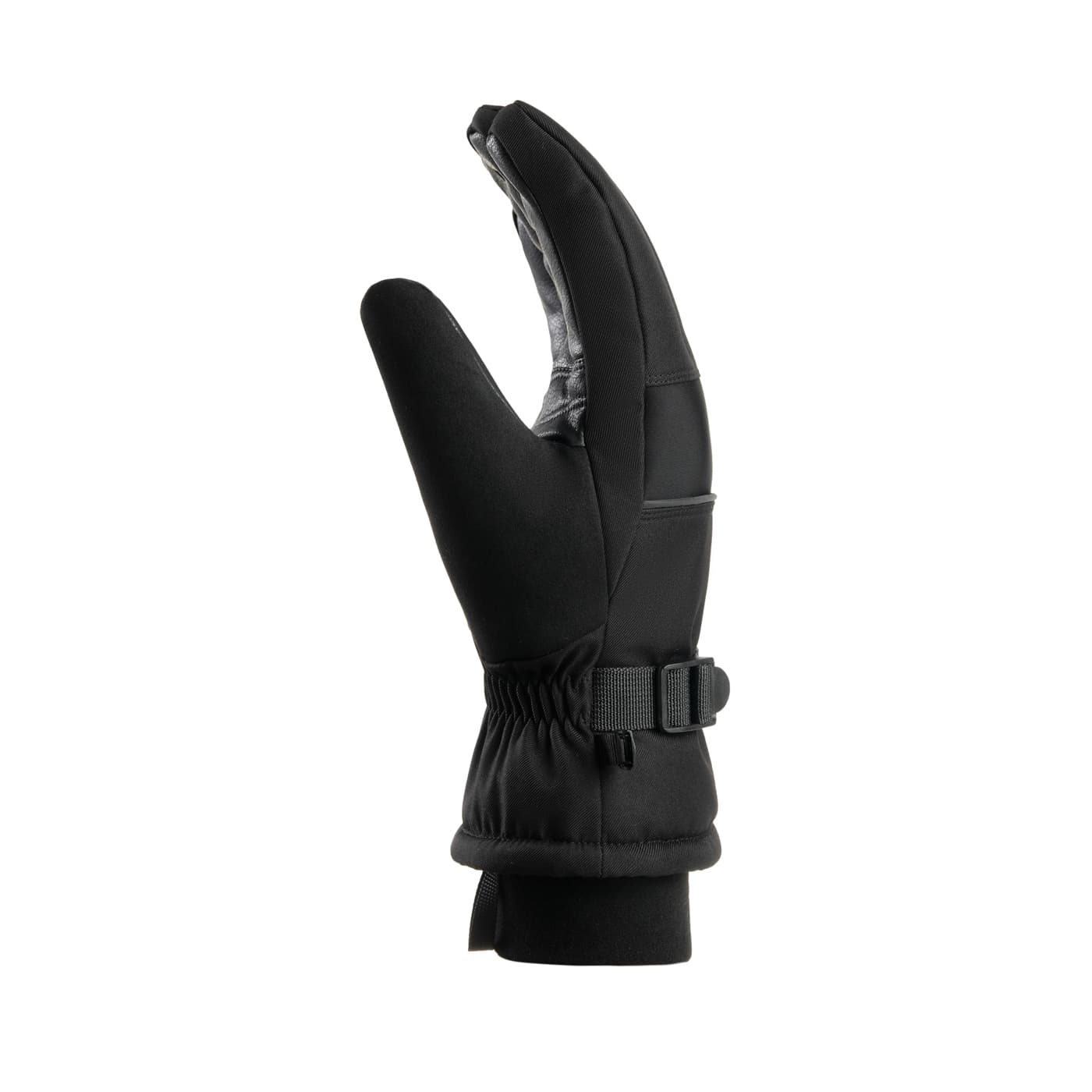
The short answer: test the cuff with the jacket you will wear
You are pushing a stroller into a crosswind, reaching for a dog leash or lifting a snow shovel. The glove itself feels warm, but every time your arm straightens a strip of wrist appears between the cuff and sleeve. A thick hand section cannot compensate for an open seam at the place two garments meet.
There is no universal answer to whether gloves should go over or under jacket sleeves. Put on the actual jacket, set the cuff for its intended position, then raise your arms, reach forward and bend your wrists. Choose the arrangement that keeps coverage while your arms move, stays comfortable and does not create a hard band. A cuff is a coverage feature, not a promise of a sealed waterproof joint.
| Your jacket sleeve | Try first | Pass when |
|---|---|---|
| Narrow, close-fitting opening | Try the glove cuff under the sleeve if it can sit flat. | The jacket covers the cuff without bunching or pushing the glove down. |
| Wide or bulky shell sleeve | Try the glove over the sleeve if its cuff can open around it. | The cuff covers the jacket edge and stays put when you reach. |
| Snow or wet-snow activity | Brush away snow and inspect the opening before starting. | There is no obvious path for snow to collect at the wrist. |
| Two stretch cuffs together | Flatten each layer and adjust gradually. | Coverage is stable without a tight ridge or tingling hand. |
Why a gap appears only after you start moving
At rest, the sleeve and glove can overlap neatly. When you extend your arm, the jacket sleeve moves up the forearm while the glove moves with the hand. When you flex your wrist, fabric folds on the palm side and tension changes at the back. A cuff that looked long enough in front of a mirror can expose skin during the exact movement your activity requires.
The handoff can also fail because the layers are bulky rather than too short. A jacket cuff pushed inside a glove may form a thick roll that prevents the glove from reaching the wrist. A glove cuff placed over a stiff jacket sleeve may ride up as the sleeve catches. Check the shape and direction of the overlap, not just the nominal cuff length.
REI's glove buying guide describes long gauntlet cuffs as extending over jacket sleeves and wrist cinches as a way to keep handwear secure. Those features help only when the glove and jacket fit together. They do not turn every over-sleeve arrangement into a sealed barrier.
Decide over or under by looking at both openings
- Put on the base layers, jacket and gloves in the order you normally use them. Do not test a cuff over a shirt sleeve if the real outing uses a padded coat.
- Look at the jacket opening. If it is close and smooth, placing a flat glove cuff underneath may create the cleaner overlap. If it is wide or stiff, a long glove cuff may cover it more reliably from the outside.
- Move the arms in the direction of the activity: forward for a stroller or handlebars, up for a reach, down for a leash or shovel. Watch for exposed skin and for either cuff pulling the other out of place.
- Try the wrist adjustment only after the overlap is right. The goal is stable coverage without squeezing the wrist; tightening cannot fix a cuff that is trapped on the wrong side of the sleeve.
- Repeat the test with a few snowflakes or light rain only if you can do it safely, then inspect the opening. This is an outfit check, not proof that the glove is waterproof.
Keep the opening easy to undo. You may need to remove a glove, open a jacket pocket or change a wet layer. A very tight cuff that cannot be adjusted with cold fingers can create its own problem, especially when you are helping a child or handling a leash.
Long cuffs, short cuffs and wrist adjustments solve different problems
A long cuff gives you more material to overlap with a jacket and can reduce the chance of a bare wrist during ordinary movement. A short cuff can be easier to put under a narrow sleeve and may suit indoor-outdoor transitions. An adjustable wrist strap can help hold a glove in place, but it is not the same as extending the cuff or blocking water at the sleeve opening.
Choose the smallest feature set that matches the activity. For a quick dog walk in a close coat, a low-profile cuff may be enough. For repeated snow contact, a longer cuff and a compatible jacket sleeve give you more coverage to manage. For a child, easy on-and-off and an adult's ability to inspect the overlap can matter more than the longest available cuff.
Cold-environment guidance from CCOHS recommends layers and closures that can be adjusted to activity and weather, while warning that excessive sweating makes clothing wet and reduces insulation. A cuff that holds coverage but forces the whole hand into uncomfortable pressure is not a successful fit.
When snow or rain reaches the cuff
Treat moisture at the wrist as information. If the cuff is wet first, brush off loose snow, step under cover and fix the jacket overlap before continuing. If the palm is damp while the cuff is dry, sweat may be the larger factor; open a layer during a break and change to a dry glove if needed. The wet-inside snow guide walks through that distinction without treating one damp spot as a laboratory leak result.
- Check the opening before entering snow, not only after the glove feels cold.
- Keep a dry pair in a separate bag for a long outing or child-sized gear kit.
- Do not keep packing snow into a cuff to test a label; repeated wet contact is a different demand from brief exposure.
- After the outing, dry the lining and inspect the cuff before storing the gloves. A damp glove can start the next trip already compromised.
For more on fit, use the three-movement glove fit check before you decide that the cuff itself is the only issue. Wrist coverage, finger position and grip all change when layers move together.
Where the Aerynx X2 Daily and X3 Winter fit
The 2026 Aerynx X2 Daily is a candidate when you want an extended cuff with a waterproof soft-touch shell, wind-blocking middle layer, graphene-fiber fleece lining, silicone palm grip and three-finger touchscreen. The 32–50°F (0–10°C) solo range is brand use guidance, not a tested rating. The 2026 design is intended for wet-weather wear, not soaking or submersion; water can still find a route at seams and the cuff. Check that the product details for the version you buy match the 2026 design rather than assuming every marketplace unit is new stock.
The Aerynx X3 Winter takes a different approach with a long cuff, wrist adjuster and six-layer construction. Its palm is microfiber PU synthetic material, not leather, and it has no published temperature rating. X3 is not for soaking or submersion, so the cuff test still matters even when the glove has a structured weather build. Use the jacket you own to decide whether that long cuff can actually sit over or under the sleeve without a gap.
Questions about glove cuffs and sleeves
Cuff and sleeve fit
- Is a long cuff always warmer?
- Not always. A long cuff can provide more overlap, but the jacket opening, the activity and the way the layers move decide whether coverage remains in place. A short cuff that fits your coat cleanly can work better than a long one that bunches.
- Should I tighten the wrist strap as much as possible?
- No. Adjust it until the glove stays in position without a hard band, pressure or tingling. A tighter strap cannot repair a gap created by the wrong over-or-under arrangement.
- Why does my child show bare wrist when reaching up?
- The jacket sleeve and glove cuff may be moving in opposite directions, or the glove may be too short or too loose. Try the full coat-and-glove movement test, then change the overlap or choose a different cuff shape.