The short answer: wet inside is a clue, not a diagnosis
You make a few snowballs, brush snow off a sleeve and notice damp fabric against your palm. It is tempting to decide that the glove leaked. But the same wet feeling can come from snow entering the cuff, water working through an exposed construction, or sweat building up while you play.
For gloves wet inside in snow, find the first place that became damp before changing your conclusion. Check the palm, fingertips, cuff and back of hand separately. Remove loose snow, take a dry break and compare the result after a short return. If the lining is wet or your fingers are numb, painful or changing color, stop the activity and warm up; do not use a waterproof label as a reason to keep going.
| What you notice | Possible route | Next action |
|---|---|---|
| Palm and fingertips become damp during active play | Sweat or moisture trapped inside. | Pause, open the outer layer if possible, and change to a dry pair before standing still. |
| Cuff is wet first | Snow or meltwater entered at the opening or jacket overlap. | Brush snow away, fix the overlap and inspect the sleeve before returning. |
| One seam or one panel is damp after repeated contact | A local entry point or saturated face fabric. | Stop pressing wet snow against that area and note the exact location for later inspection. |
| The whole lining is damp after a long outing | Accumulated sweat, outside moisture or both. | Go indoors, remove the wet layer and dry it fully; carry a spare for the next outing. |
Water can arrive by three different routes
First is outside contact. Snow that falls lightly on a surface is not the same as wet snow repeatedly squeezed in a hand. A face treatment can help water bead on a textile, while a membrane is a separate barrier in a waterproof construction. GORE-TEX Professional's DWR explanation describes DWR as a surface treatment and the membrane as the waterproof element in its products; a bead on the face cannot tell you what happened at the cuff or inside the glove.
Second is the opening. A long cuff can cover more of the wrist, but it cannot close an uncovered gap between glove and jacket. Snow pushed up a sleeve can melt inside the cuff even when the glove body is otherwise appropriate for the weather. That is why the glove-cuff and jacket-sleeve guide treats the two garments as one moving interface.
Third is sweat. Snow play, shoveling and energetic running can make a waterproof or highly weather-resistant glove feel wet from the inside. REI's glove buying guide explicitly tells readers to consider moisture both outside and inside the handwear and notes that even waterproof gloves can get wet from the inside. Your first response should be to reduce heat and moisture, not to add another layer over the damp one.
Why making snowballs is harder on a glove than walking through snow
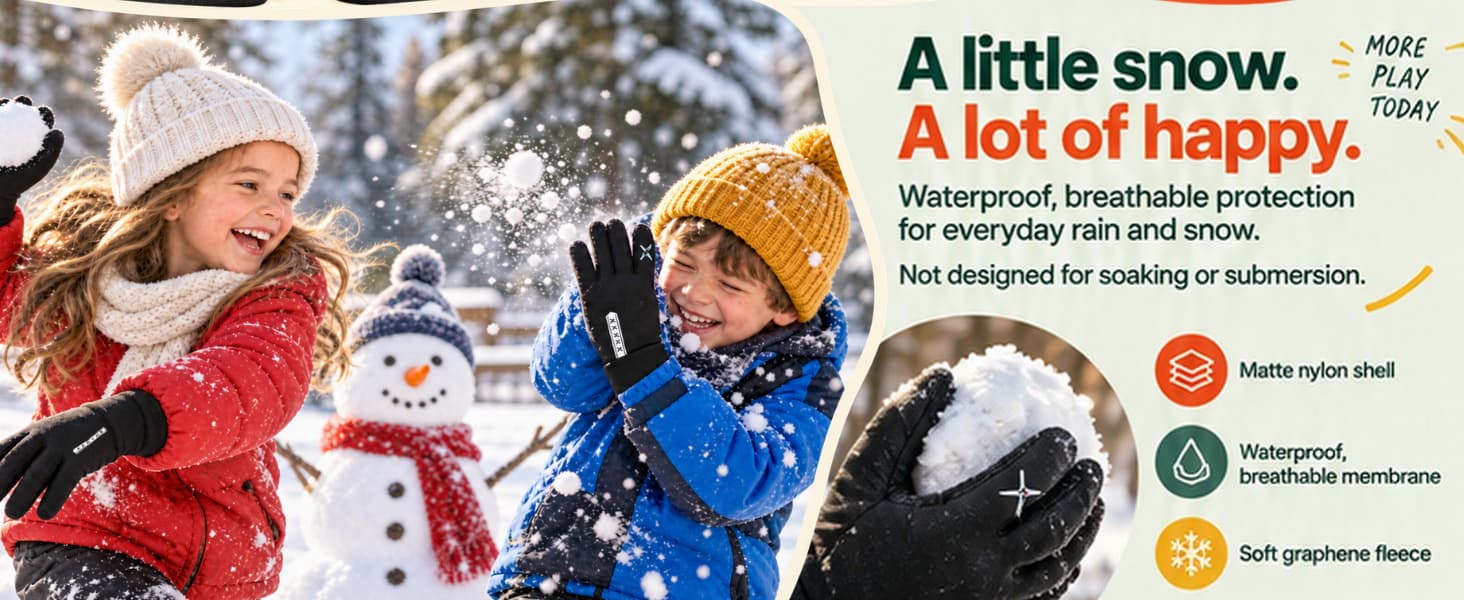
A walk through falling snow may give the glove short, scattered contact. Making snowballs gives it repeated contact with cold, wet material, plus squeezing and bending. Snow can be pushed into a cuff, packed against a seam or held against the palm long enough to melt. Those are different conditions from seeing a few flakes land on the back of your hand.
- Before play, make sure the hand and lining start dry. A glove that is damp in the gear bag will only become harder to assess outside.
- During play, check the cuff and palm at a planned pause rather than waiting for a child or adult to say the glove feels cold.
- Brush loose snow off before it melts, and do not keep packing wet snow into a glove opening just because the glove is labeled waterproof.
- If one glove is wetter than the other, compare the hand position, sleeve overlap and snow contact instead of assuming the pair failed identically.
These checks locate a likely route; they are not a controlled water-ingress test. A photograph of a damp palm cannot prove whether water crossed the glove body, arrived at the cuff or came from perspiration.
Use pauses to inspect, dry and swap
Build a glove check into the outing. For adults, that may be when you refill a drink or return to the car. For children, make it part of the indoor break rather than asking whether they are cold while they are still absorbed in play. Look at the skin and the lining, and ask whether the hand can open, close and hold an object normally.
- At the first break, remove the gloves and identify whether dampness starts at the fingertips, palm, back or cuff.
- Put wet gloves in a separate bag and use the dry pair. Do not put the wet pair back on a warm hand and call the problem solved.
- At home, open the gloves as far as the construction allows and let them dry according to the maker's care directions; the inside-drying guide covers why the lining needs its own time.
- Before the next outing, check the jacket sleeve and cuff combination, because a repeated wet entry point will make a new pair wet in the same way.
The American Academy of Pediatrics winter guidance recommends warm, dry, breathable clothing, indoor breaks and changing out of wet clothes right away for children. That is a useful family routine even when the glove label makes a stronger weather claim.
Choose the construction and the boundary
If snow contact is occasional, a water-resistant glove may be enough when you keep the cuff covered and have a dry spare. If the activity involves repeated wet-snow contact, look for a stated waterproof barrier or insert, a cuff that works with your coat and care instructions you can follow. Still, waterproof is not the same as suitable for soaking or submersion, and no cuff can promise that water will never find its way in.
For a child who can manage the fit and whose hand you measure against the available guidance, Aerynx X0 Kids combines a nylon shell, membrane, graphene-fiber fleece lining, silicone dot grip, three-finger touchscreen and a long cuff. There is no verified X0 age chart, hand-size chart or temperature rating to borrow, so check the product guidance and contact support if the fit is unclear. It is not made for soaking, and the cuff still needs to work with the child's coat.
For an adult who wants a more structured wet-weather glove, Aerynx X3 Winter uses a six-layer build with a nylon shell, membrane, synthetic insulation, separate waterproof insert, inner insulation and short-pile fleece, plus a long cuff and wrist adjuster. X3 has no published temperature rating and is not for soaking or submersion; seams and the cuff remain places to monitor. Keep a dry replacement with either choice when the outing is long or hands will repeatedly touch snow.
Questions about wet gloves in snow
Wet gloves in snow
- Does a wet palm prove that the glove leaked?
- No. Sweat, snow entering at the cuff and moisture crossing a construction can feel similar. Check which area became damp first, then repeat the activity with a dry glove and a better sleeve overlap if possible.
- Why can a waterproof glove still get wet inside?
- Waterproof construction addresses a barrier, not every opening or every source of moisture. Snow can enter at the cuff, and sweat can build up inside during active play. Waterproof also does not mean safe for soaking or submersion.
- Should I wait until a child says their hands are cold?
- No. Children may stay focused on play, so check gloves during indoor breaks and change wet clothing promptly. Pain, numbness, unusual color or loss of normal hand use is a reason to stop and warm up.