Subtraction is a design choice, not an absence of thought
Adding a feature is easy to describe. A pocket, a weather barrier, a larger cuff, a stronger panel, or another layer can all be presented as progress. Removing one asks a harder question: what work was that feature supposed to do, and does this hand actually need it? Our starting point is the ordinary cold-weather moment—walking, riding, driving, carrying, and using a phone—not a fictional expedition that asks one glove to solve every climate.
The point of subtraction is not to make a glove cheap by leaving holes in the brief. It is to make the remaining decisions legible. A clear comfort window is easier to use than a dramatic adjective. A water-repellent face with an explicit boundary is more useful than a vague waterproof implication. A specified touch layout is more honest than saying every fingertip works. A glove becomes easier to choose when the edges are visible.
Because Aerynx makes these products, this page is a design explanation, not an independent review. The product pages and current listings are the sources for specifications and purchase terms. The design principle is ours; the facts need to remain checkable.
What stayed because the hand uses it
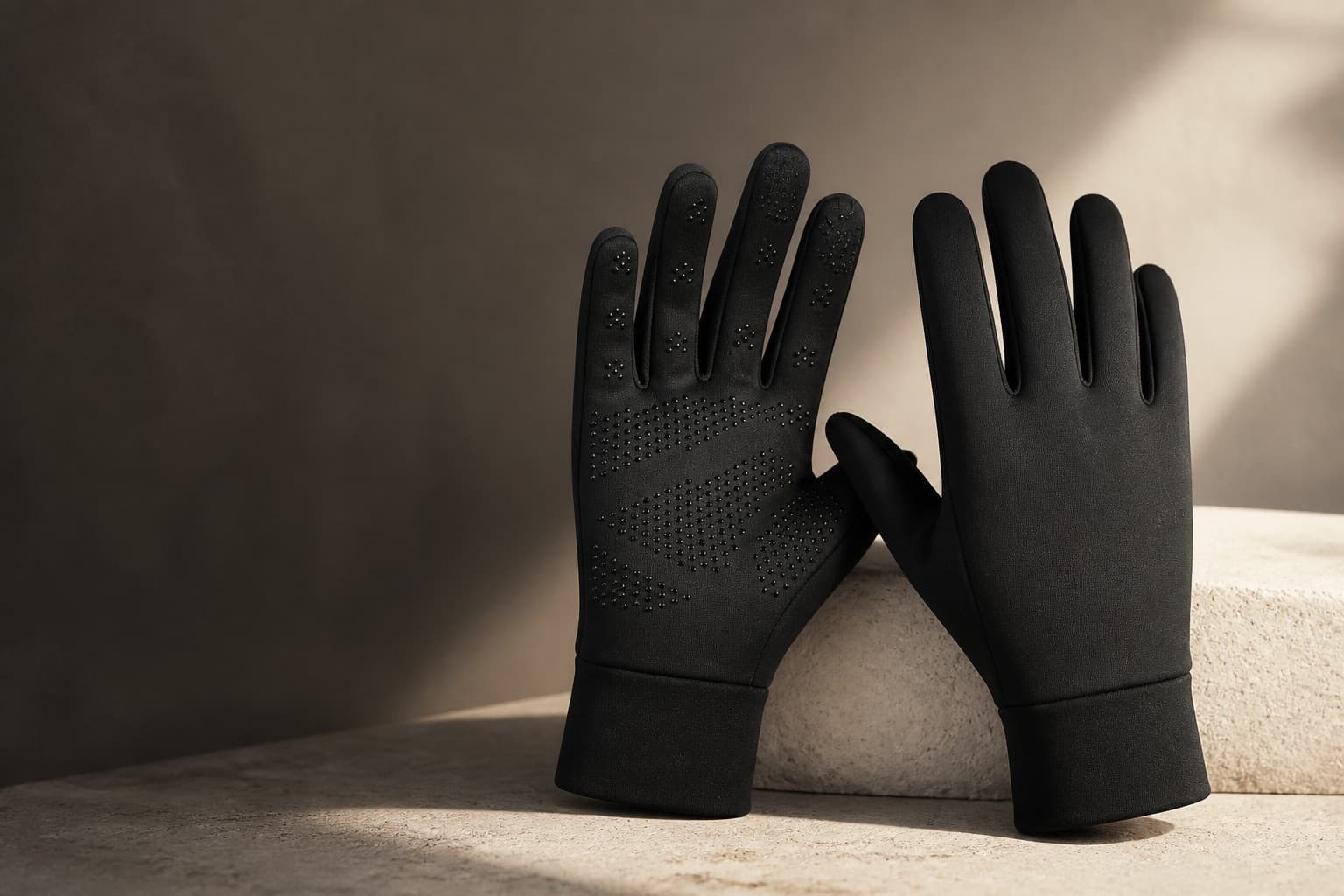
X1 keeps a four-way-stretch shell, 320 gsm fleece interior, DWR water-repellent finish, silicone grip, and conductive touch yarn at the thumb, index, and middle fingertips. It is specified for 5–15°C (41–59°F) and listed at $18.99 under ASIN B0FM468WQC. Those are not decorative details. Stretch supports reach, fleece gives a defined insulation layer, grip keeps an object from sliding, and three touch-ready fingers remove a repeated reason to expose bare skin.
X2 keeps a different answer for colder active use: a knit shell, wind-blocking mid-layer, and 320 gsm fleece. It is specified for 0–10°C (32–50°F), carries the same thumb, index, and middle touch layout and silicone grip, and is listed at $20.98 under ASIN B0FM479G1V. Below about −4°C (25°F) or in long wet cold, the comfort-use guidance is to add an appropriate shell. The boundary is part of the design, not an apology for it.
| Decision | X1 | X2 |
|---|---|---|
| Temperature guidance | 5–15°C / 41–59°F | 0–10°C / 32–50°F |
| Core construction | Four-way stretch shell + 320 gsm fleece | Knit shell + wind-blocking mid-layer + 320 gsm fleece |
| Weather boundary | DWR water-repellent, not waterproof | DWR water-repellent, not waterproof |
| Useful contact | Thumb, index, middle touch; silicone grip | Thumb, index, middle touch; silicone grip |
| Support | One-year support against manufacturing defects | One-year support against manufacturing defects |
What we decline to claim
We do not turn a product image into an independent experiment. We do not invent a rain test, a ranking, a laboratory warmth score, or a field result that has not been logged. We do not present a water-repellent finish as waterproof, and we do not make a clinical promise to people with cold-sensitivity concerns. A design page should reduce uncertainty, not decorate it.
The same discipline applies to the marketplace. Amazon is where the current purchase happens; delivery, returns, availability, and the seller presentation can change with the listing. The official site is the entity and specification home. We identify the current seller as BeiMiu in source disclosure when needed, without turning a fulfillment arrangement into a permanent brand fact.
This restraint has a practical benefit. When a customer asks whether X2 is suitable for a wet 20-minute commute, the answer can point to its three layers, DWR boundary, temperature guidance, and shell option. When they ask whether X1 will operate a phone, the answer can point to three named fingertips and a fit check. The customer gets a decision instead of a cloud of promises.
Longer use starts with an honest repair conversation
A damaged glove should not be discarded automatically. A worn touch area, loose seam, or small defect may have a repair or refurbishment path, depending on the condition and the available service. Within one year, the current support promise covers manufacturing defects. After that period, contact support with order details and clear photos so the team can assess what is possible. Assessment is not a promise that every repair will be economical or available.
The care boundary matters before repair. Both current gloves are Hand Wash Only. Mild detergent, line drying away from heat, and a dry storage place are small acts of maintenance. Bleach, softener, tumble drying, and ironing add stress that can change stretch, fleece, grip, and conductive areas. A repair-first attitude works better when the material has not been made harder to assess by avoidable heat or residue.
Repair is also a design feedback loop. If a touch patch wears in a predictable place, the answer may be a construction change. If a cuff is hard to layer, the answer may be a pattern change. Subtraction is not a vow never to add; it is a habit of adding only when the use and evidence justify it.
Price is a constraint that keeps the purpose visible
The current prices are public: $18.99 for X1 and $20.98 for X2. A lower price does not make a glove universally better, and a higher price does not make a glove more suitable for a particular forecast. Price is useful here because it keeps the design question concrete. What should a customer receive for a simple, active cold-weather job? The answer should fit the construction and the limits we actually publish.
That means not charging a customer for a feature that solves a different category while implying it belongs here. It also means naming the moment when the product is wrong: X1 is not the choice for the colder 0–10°C anchor, X2 is not a waterproof glove, and neither pair claims to replace a dedicated static cold-weather system. A product earns trust when it can say no without hiding the useful yes.
- Use X1 when 5–15°C / 41–59°F and a lighter, stretch-led glove fits the activity.
- Use X2 when 0–10°C / 32–50°F and moving air calls for a wind-blocking middle layer.
- Add a shell for steady wet weather or long outings below about −4°C / 25°F.
- Contact support about defects, repair, or refurbishment instead of assuming replacement is the only path.
Questions readers ask
The design boundary
- Is subtractive design the same as making a basic glove?
- No. It means choosing a smaller set of features that serve a defined use, then stating the limits clearly. X1 and X2 retain stretch, fleece, grip, and three named conductive fingertips for their respective temperature jobs.
- Does Aerynx promise lifetime repair?
- No. Current support is one year against manufacturing defects. After that, contact support with photos and order details for a repair or refurbishment assessment when possible.
- What is deliberately outside this design brief?
- A waterproof promise, an extreme-cold guarantee, a medical claim, and an independent test result are outside the published brief. Use a shell or another category when the job requires it.