Name the boundary before you buy
Water-resistant, water-repellent, and waterproof are not interchangeable. Water-repellent usually describes a surface treatment that encourages light droplets to bead and roll away. Water-resistant is broader: a construction may slow water entry for a while without stopping it indefinitely. Waterproof is the strongest boundary and normally requires a construction and seam treatment intended to keep liquid water out under defined conditions. A product page should tell you which claim it actually makes.
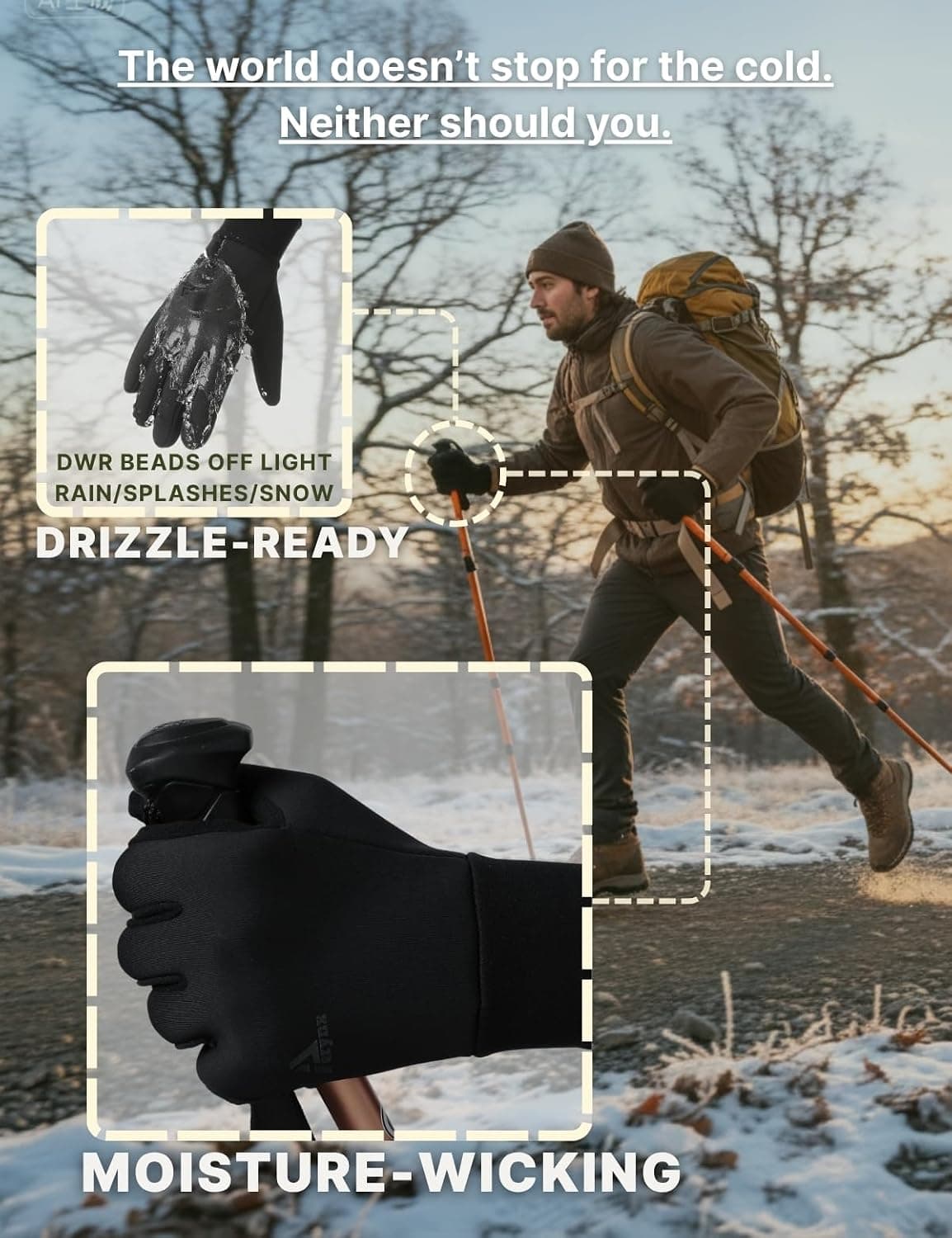
The current Aerynx X1 and X2 are water-repellent, not waterproof. Their DWR-treated faces can shed light rain and road spray. That is useful for an ordinary cool commute or a short run through drizzle. It does not mean the seams are sealed, that the glove can be submerged, or that it will stay dry through steady rain. A waterproof shell remains the right tool when the forecast asks for a sustained barrier.
Being precise is not a downgrade. A water-repellent glove can be more comfortable for active use when the main problem is wind and intermittent moisture. A waterproof glove can be the better answer for wet snow, a long exposed descent, or work that involves repeated contact with water. The choice is a weather decision, not a ranking of one adjective over another.
What DWR does in a layered glove
X1 combines its DWR face with a four-way-stretch shell and 320 gsm fleece interior, and X2 combines a knit shell, wind-blocking mid-layer, and 320 gsm fleece. In both cases, the surface treatment is one layer of the weather strategy. The wind-blocking middle layer in X2 helps with moving air, while the face deals with brief droplets. Neither fact should be stretched into a waterproof promise.
A shell changes the system. It can add the sealed or more weather-focused outer boundary that the everyday glove intentionally does not provide. Leave room for the layers to move and keep the fingers aligned with the conductive thumb, index, and middle patches. A shell that compresses the hand can trade water protection for poor circulation and poor control.
| Situation | What a water-repellent glove can do | What to add or choose | Why |
|---|---|---|---|
| Brief drizzle or road spray | Shed light droplets at the face | Use X1 or X2 within its comfort window | The exposure is short and intermittent |
| Steady rain or wet snow | May eventually admit water at fabric or seams | Add a waterproof shell | A sustained outer barrier is the missing layer |
| Below about −4°C / 25°F | X2 may serve as a warm inner layer | Add an appropriate shell for long outings | Comfort depends on insulation and wind protection together |
| Repeated water handling | Not the intended job | Choose a dedicated waterproof glove | The task needs a different construction boundary |
Sweat is water, too
Running gloves have an inside weather problem. Your hands can produce moisture even when the air is cold, especially when the pace rises or the glove is worn past the point where it is needed. A more sealed construction can reduce incoming rain but may also slow the movement of vapor. That is a breathability tradeoff, not proof that waterproof always makes a hand colder. Humidity, effort, lining, fit, and time all matter.
If your palms finish damp, first ask whether the glove was too warm for the effort. At the warmer end of its range, X1 may be the better choice; near 0–10°C, X2 gives more wind structure. You can also remove a glove for part of the route or carry a shell separately. A glove that can be adjusted is often more useful than one selected only for the coldest five minutes.
Dryness is not the same as comfort. A totally dry outer surface can coexist with a wet lining, and a little surface dampness can be harmless during a short active effort. Watch for cold fingers, loss of dexterity, or fabric that stays wet after the activity. Those are signals to change the layer system, the pace, or the category next time.
The hard line: not waterproof
The useful sentence is short: X1 and X2 are DWR water-repellent, not waterproof. The everyday glove is not a complete rain barrier. If a run is expected to be long and wet, place a waterproof shell over the glove or choose a waterproof glove designed for that job. Do not rely on a water-repellent face for snow play, standing rain, or repeated immersion.
The same boundary applies to product photography and care. A picture of droplets is evidence of a visual scene, not a hydrostatic test. A clean DWR finish can shed light moisture, but treatment wear, dirt, abrasion, and washing change surface behavior. We do not publish a water-column number or independent rain result for these pairs because we do not have one to stand behind.
Care without turning treatment into a ritual
Both current pairs are Hand Wash Only. Use mild detergent, rinse well, and line dry away from direct heat. Avoid bleach, softener, tumble drying, and ironing. Store the glove fully dry. These steps reduce residue and heat stress that can affect stretch, fleece, grip, and touch areas. They do not make a water-repellent glove waterproof, and they cannot reseal an unsealed seam.
If the face stops beading after normal use, do not assume that adding a treatment is always the right next step. Check the current product instructions or ask support first. More product is not automatically more protection, and a treatment that changes hand feel may not suit a close touchscreen fit. The durable choice is the one that matches the next outing and respects the material boundary.
Weather questions
- Are Aerynx X1 or X2 waterproof?
- No. Both are DWR water-repellent, not waterproof, so use a waterproof shell for steady rain, wet snow, or long exposure.
- Will a waterproof glove always make hands sweat?
- No. A waterproof construction can change moisture movement, but comfort depends on effort, humidity, fit, lining, and duration. Treat breathability as a tradeoff rather than an absolute.
- Can I wear X2 under a shell?
- Yes, as comfort-use guidance below about −4°C / 25°F or in wet cold, if the shell leaves enough room for circulation and fingertip alignment.