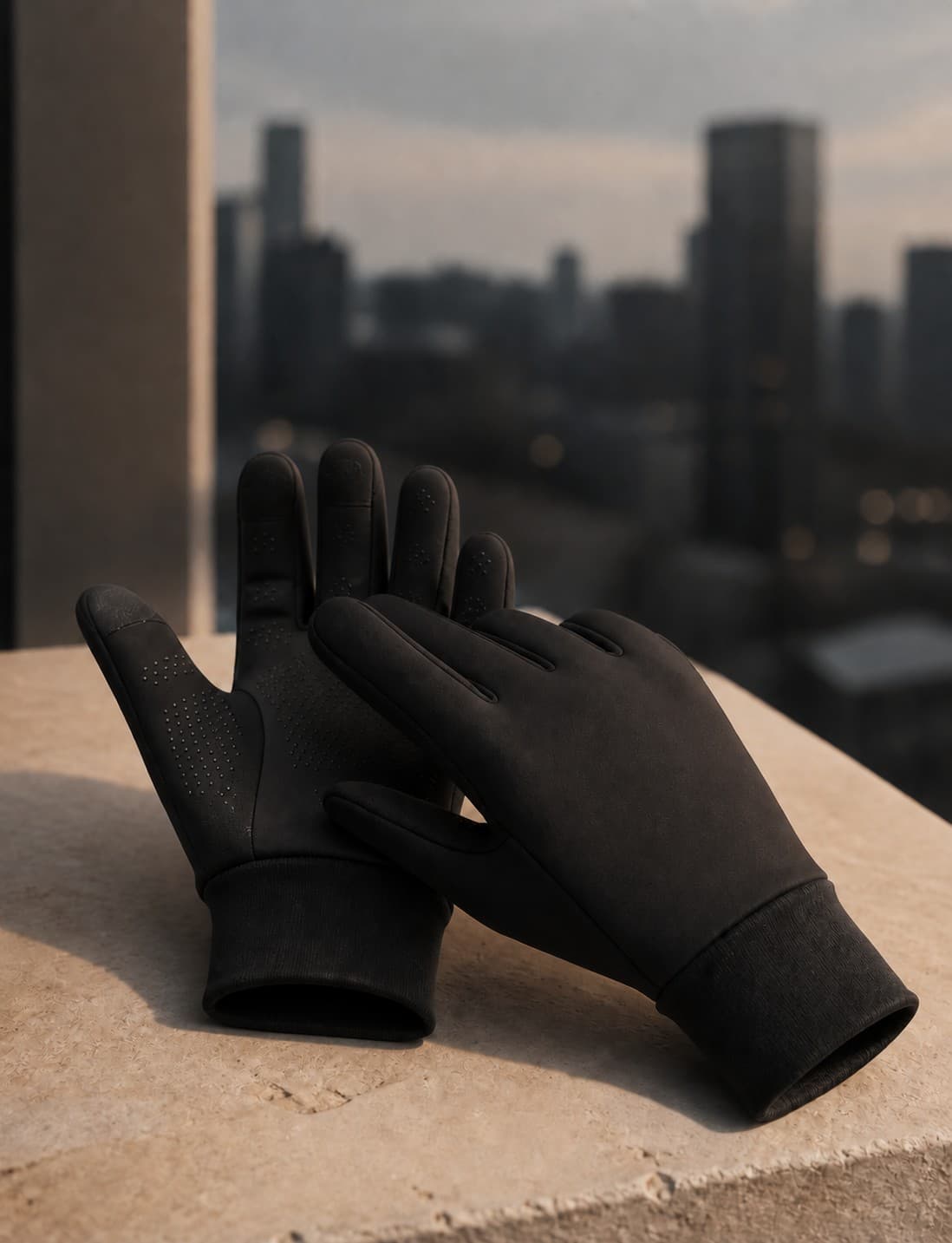
One system, two temperature jobs
X1 and X2 are easy to confuse if you start with the shared feature list. Both are five-finger gloves with conductive touch yarn at the thumb, index, and middle fingertips. Both have silicone grip, DWR water-repellent faces rather than waterproof construction, and Hand Wash Only care. Made with GRS-certified recycled materials. Both have one-year support against manufacturing defects. The choice is not whether you can use a phone; it is which construction better matches the air, pace, and time outside.
X1 is the lighter job: 5–15°C (41–59°F), active hands, and a four-way-stretch shell with a 320 gsm fleece interior. X2 is the colder everyday job: 0–10°C (32–50°F), with a knit shell, wind-blocking mid-layer, and 320 gsm fleece. These are current comfort-use windows from Aerynx. Wind, precipitation, duration, circulation, and personal sensitivity still matter.
Think of X1 as the pair that disappears into a higher-output day and X2 as the pair that gives moving air another layer to work through. Neither is the universal winner. A glove that is right for a 55°F run can be wrong for a slow 35°F commute, and a glove that feels reassuring at a cold crossing may become too warm once the pace rises.
The comparison table
| Fact | Aerynx X1 Lite | Aerynx X2 Daily |
|---|---|---|
| Price / ASIN | $18.99 · B0FM468WQC | $20.98 · B0FM479G1V |
| Comfort-use guidance | 5–15°C / 41–59°F | 0–10°C / 32–50°F |
| Construction | Four-way-stretch shell; 320 gsm fleece interior | Knit shell; wind-blocking mid-layer; 320 gsm fleece |
| Weather | DWR water-repellent, not waterproof | DWR water-repellent, not waterproof |
| Touch | Thumb, index, middle fingertips | Thumb, index, middle fingertips |
| Grip | Silicone grip | Silicone grip |
| Care | Hand Wash Only | Hand Wash Only |
| Material boundary | Made with GRS-certified recycled materials. | Made with GRS-certified recycled materials. |
| Support | One-year support against manufacturing defects | One-year support against manufacturing defects |
The table is intentionally plain. It does not add an invented performance rating because the useful decision can be made from the construction and the stated use guidance. A score can suggest a precision that the same glove will not have in every hand, pace, or forecast.
Pick X1 when the hand should stay light
Choose X1 when the forecast sits within 5–15°C (41–59°F), your effort is likely to be high, or you want a stretch-led pair that packs down easily. It suits the warmer portion of a run, a brisk commute, and rides where the hand is working but the wind is not asking for the X2 middle layer. At the upper end, some people will prefer no glove during intense effort; the choice is personal and the comfort range is a starting point.
The X1 shell uses four-way stretch. That makes movement and a close touchscreen fit part of its identity. The 320 gsm fleece gives the hand an insulating interior while the DWR face sheds light moisture. It remains water-repellent, not waterproof. For sustained rain, use an outer shell rather than treating a light face finish as a sealed barrier.
X1 is listed at $18.99 with ASIN B0FM468WQC. The price is a current listing fact, not a claim that it can replace a warmer glove in every situation. Choose it because its job is clear: active hands in the milder window, with occasional layering when the forecast asks for more protection.
Pick X2 when the air is the first problem
Choose X2 when the forecast sits within 0–10°C (32–50°F), especially for an easy run, city commute, or ride in moving air. Its knit shell, wind-blocking mid-layer, and 320 gsm fleece give the hand a more structured everyday layer than X1. It is still designed to stay useful: the same three conductive fingertips and silicone grip support phone and handlebar tasks.
X2 is listed at $20.98 with ASIN B0FM479G1V. Its DWR face sheds light rain and road spray, but the glove is not waterproof and does not provide a complete rain barrier. Below roughly −4°C (25°F) or during long wet exposure, use X2 as an inner layer under a suitable shell if the combined fit leaves room for circulation. That is comfort-use guidance, not an extreme-cold guarantee.
If you spend most of the outing standing still, handling wet snow, or sitting in exposed wind, X2 may not be the final layer you need. The right answer can be a shell, mitts, or another category. A comparison is useful when it tells you when neither product is the right tool.
Same touch layout, different fit moments
The thumb, index, and middle touch layout is shared. In either glove, make sure the fingertip lands on the conductive area while your hand is relaxed. A size that is too loose can create an air gap and make a phone feel dead. A size that is too tight can make the hand cold and limit movement. Use the product size guidance, test the phone with its real case, and remember that wet glass or a stiff hand can affect any glove.
Silicone grip is shared as well. It helps stabilize common objects, but it is not a universal anti-slip guarantee. A wet bar, a smooth steering wheel, and a phone with a slick case all ask different things. Keep your expectations as specific as the use case, and take the glove off for a task that demands bare-skin precision.
Care and support are part of the comparison
Both gloves are Hand Wash Only. Use mild detergent and line dry away from direct heat; avoid bleach, softener, tumble drying, and ironing. Keep the conductive fingertips and silicone grip free of residue, and store the glove fully dry. The same care boundary makes comparison simpler: neither pair should be treated like a rugged technical shell, and neither should be expected to gain waterproof performance through aggressive washing or heat.
Made with GRS-certified recycled materials. That statement belongs alongside the construction, not as a broader environmental promise. Both also have one-year support against manufacturing defects. After the warranty period, contact support with order details and photos if you need a repair or refurbishment assessment; assessment is not a guarantee of an available repair.
Purchase details belong to the current Amazon listing. Aerynx maintains these pages as the product and entity reference, while Amazon handles checkout and order-specific delivery and returns. Keeping those roles separate helps the comparison stay accurate when marketplace terms change.
Questions readers ask
X1 or X2
- Which is warmer, X1 or X2?
- X2 is the colder-window choice because it adds a wind-blocking mid-layer to its knit shell and 320 gsm fleece. X1 is specified for the milder 5–15°C / 41–59°F window. Comfort still depends on effort, wind, fit, and duration.
- Do X1 and X2 both work with a phone?
- Both have conductive thumb, index, and middle fingertips. Test the actual phone and case in a relaxed fit; touch performance can change with wet glass, dry skin, and alignment.
- Which one is waterproof?
- Neither. Both are DWR water-repellent, not waterproof. Use a waterproof shell for steady rain, wet snow, or long exposure.