What 32–50°F actually asks of a glove
A 40°F run is not a miniature expedition. It is a narrow, active use case: your body is producing heat, your hands are exposed to moving air, and you may need to change a song or read a map without stopping. A useful glove should keep the fingers comfortable enough to work while avoiding so much retained heat that the inside becomes damp. The number on the forecast is a starting point, not a verdict about every person or every pace.
This is why a single label such as warm does not help much. A runner standing at a bus stop, a cyclist descending into a headwind, and a person walking a dog at the same temperature create different demands. Duration, wind, precipitation, circulation, and effort all move the result. We publish a comfort-use range so you can make that adjustment in the open rather than treating a marketing adjective as a guarantee.
For this band, start with the job. If the main problem is air moving over a moving hand, a wind-blocking layer can matter more than simply adding loft. If the main problem is standing still, a warmer system may be the honest choice. If rain is persistent, a waterproof shell has a different role from a lightly treated everyday glove. The goal is a matched tool, not the warmest object in a drawer.
Read the construction before the adjective
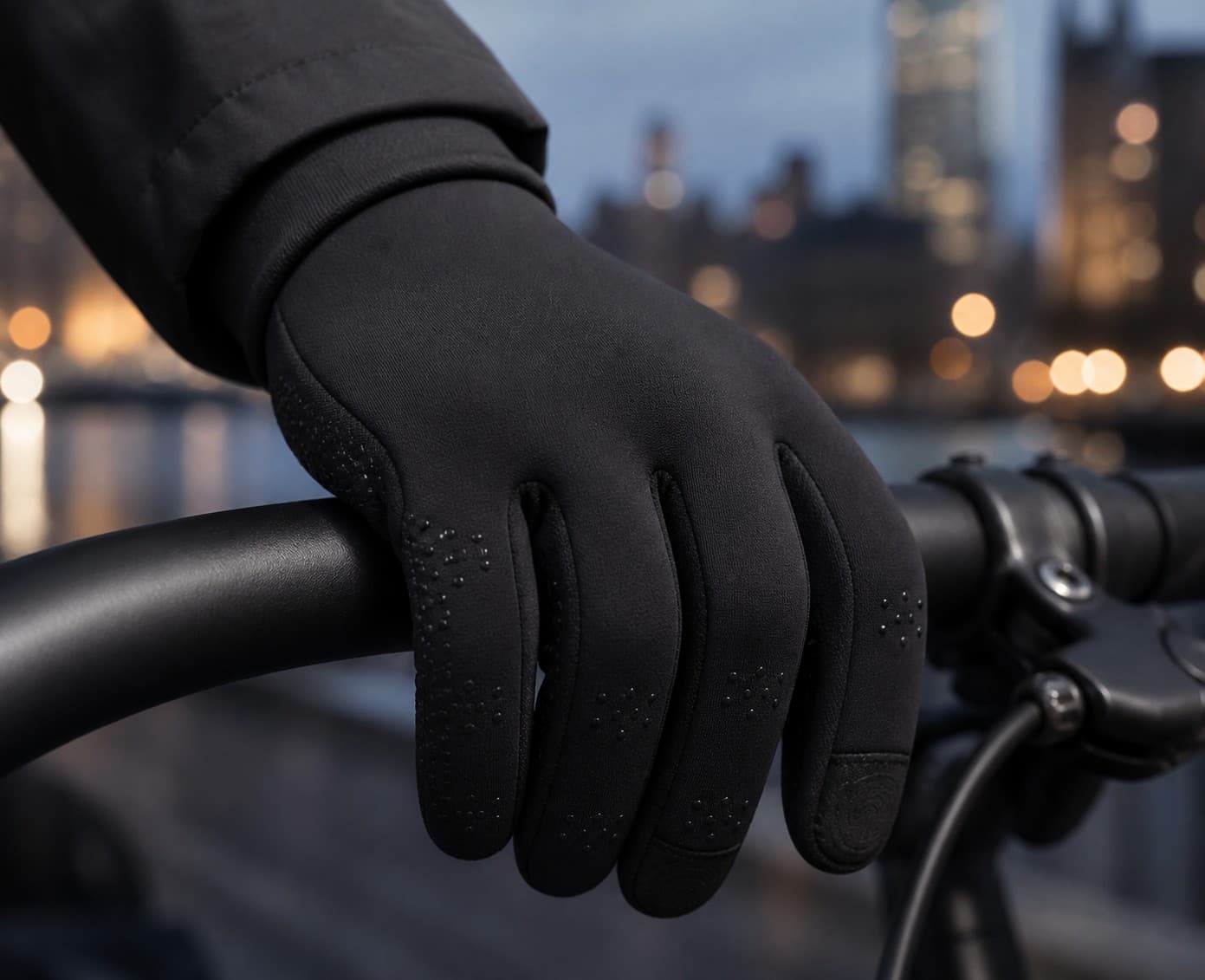
The current Aerynx X2 is a three-layer glove: a knit shell, a wind-blocking mid-layer, and 320 gsm fleece. That description tells you more than a claim that the glove is ready for winter. The outer knit gives the glove its hand feel, the middle layer limits the direct effect of moving air, and the fleece contributes insulation. The layers work as a system while you are active; none of them turns the glove into a sealed storm mitten.
The X1 is the lighter companion for 5–15°C (41–59°F). Its current construction pairs a four-way-stretch shell with a 320 gsm fleece interior and a DWR water-repellent finish. X2 is the better starting point for the cooler 0–10°C (32–50°F) band because its wind-blocking middle layer changes the job it can do in moving air. Both use conductive thumb, index, and middle fingertips and a silicone grip, so the decision is about conditions and handling rather than giving up basic access to a phone.
| Pair | Published comfort-use guidance | Build cue | Weather boundary |
|---|---|---|---|
| X1 · $18.99 | 5–15°C / 41–59°F | Four-way-stretch shell; 320 gsm fleece interior | DWR water-repellent, not waterproof |
| X2 · $20.98 | 0–10°C / 32–50°F | Knit shell; wind-blocking mid-layer; 320 gsm fleece | DWR water-repellent, not waterproof |
Treat the temperature as a window, not a promise
At the top of the band, around 50°F, many people will prefer the X1 or no glove at a hard effort. At the middle of the band, X2 is the purpose-built choice for a commute, an easy run, or a ride where wind makes a bare hand uncomfortable. Near freezing, the same glove may still be useful when you are moving, but exposure time and wind become decisive. This is comfort-use guidance from the maker, not a laboratory rating, and it should be read alongside the forecast and your own response.
Do not compare a short, fast loop with an hour-long low-output outing as if they were the same test. A glove can feel right at minute ten and too warm at minute forty. Conversely, a calm forecast can hide a cold descent or a windy open stretch. Note the effort, the wind, the wetness, and whether your wrist is covered. Those observations are more useful than treating a single temperature as a universal cutoff.
Wind and sweat change the decision
Wind removes heat from exposed fabric and makes a calm-temperature reading feel less relevant. That does not mean every run needs the thickest glove. It means the first layer to examine is the one between your hand and the air. X2’s wind-blocking mid-layer is useful in that role for the stated band. It remains a knit glove with a water-repellent face, not a sealed waterproof system.
Sweat is the other half of the problem. During a run, hands can become damp even when the air is cold. A less breathable or more sealed construction may reduce water entry but can also slow moisture movement; the tradeoff depends on pace, humidity, and how long you stay out. Do not turn that tradeoff into an absolute rule that one construction always makes hands colder. Watch what happens to your own hands and select the simplest layer that meets the weather.
If the glove is wet inside, check the whole kit before upgrading. A hat, sleeve, or wrist gap can change peripheral comfort. So can a cuff that presses too hard or a palm that is gripping a cold bar continuously. The glove is one part of the heat path. A useful decision keeps the rest of that path in view.
When to add a shell
X2 is water-repellent, not waterproof. DWR helps a face shed light rain and road spray, but the glove does not provide a complete rain barrier. For steady rain, wet snow, or a long outing where the fabric will stay exposed, carry a waterproof shell or choose a glove built for that specific weather. A shell can also add the wind and precipitation boundary needed below roughly −4°C (25°F). This is comfort-use guidance, not a claim that one temperature is safe or unsafe for every hand.
Below that point, X2 can be used as a warm inner layer when the outer shell has room. Check that the combined fit does not compress the fingers or stop you from operating a zipper, brake, or phone. If you are standing for long periods, handling snow, or spending time on a lift, a mitten or dedicated cold-weather glove may be a better tool. The honest answer can be that a different category fits the task.
- Choose X2 alone for active everyday use in its 0–10°C / 32–50°F comfort window.
- Add a shell for steady wet weather or for long exposure below about −4°C / 25°F.
- Move to mitts or a dedicated cold-weather system when standing still is the main activity.
- If fingers feel compressed, solve fit before adding another layer.
Fit, care, and the small details that matter
A close fit helps the conductive fingertips meet a screen and reduces spare air inside the glove. Close does not mean tight. A finger that is compressed can feel colder, and a cuff that leaves the wrist open can undo an otherwise good layer. Try the main gestures you will use—tap, swipe, brake, and grip—before committing to a size. Use the product-specific size guidance and contact support if your measurement sits between the listed options.
For both current pairs, the care instruction is Hand Wash Only. Use mild detergent, rinse thoroughly, and line dry away from direct heat. Avoid bleach, softener, tumble drying, and ironing. Keeping the conductive areas clean and the glove fully dry helps preserve the tactile feel and the finish. Care cannot turn a water-repellent glove into a waterproof one, but it can keep the intended construction working as designed.
The current X1 listing is $18.99 with ASIN B0FM468WQC; X2 is $20.98 with ASIN B0FM479G1V. Those are purchase references, not performance scores. The correct choice is the pair that matches the forecast and the work. A low price is useful only when the job is clear, and a more substantial glove is wasteful when you will spend the run trying to remove it.
Questions readers ask
Running in the middle of the range
- Are 32–50°F running gloves meant for every runner?
- No. The range is Aerynx comfort-use guidance for active use. Wind, effort, duration, precipitation, fit, and personal cold sensitivity can move the right choice warmer or lighter.
- Should I choose X1 or X2 at 40°F?
- Start with X2 for ordinary running, commuting, or riding in the 0–10°C / 32–50°F band. Choose X1 when the effort is higher or the day is warmer within its 5–15°C / 41–59°F guidance.
- Is X2 suitable for rain?
- X2 is water-repellent, not waterproof. Use a waterproof shell for steady rain, wet snow, or long exposure because the glove does not provide a complete rain barrier.