The short answer
It is seven in the morning, the dog has stopped to investigate a snowbank, and you are holding the leash in one hand while trying to peel a waste bag off the roll with the other. Your keys are somewhere under a zipped pocket. Take a glove off and your fingers are stiff within a few minutes; leave it on and the thin bag will not open.
The practical answer: the best winter gloves for dog walking are the thinnest pair that stays comfortable through your longest stop, holds the leash securely when it is damp, and lets you open a bag and use a key without taking them off. Test those three jobs at home before the first cold morning. Go thicker when walks are long, snowy or spent mostly standing still, and accept that extra insulation usually costs some finger feel. No glove makes an unsafe leash hold safe.
Why dog walking is harder on gloves than an ordinary walk
A dog walk asks for a steady grip on a leash for half an hour or more, a firm hold when the dog lunges at a squirrel, and a string of fine-motor jobs: opening and tying a thin plastic bag, clipping a harness, finding treats, unlocking the door. Some of them happen with a wet leash or snow on the palm.
The rhythm is different too. Dogs walk, stop, sniff, circle and walk again, so you spend more time standing than the step count suggests. Moving generates heat; standing in wind does not. Canada's occupational health agency, CCOHS, notes that clothing which gets wet loses much of its insulating value, and that layers work best when you adjust them around activity and rest. Its guidance is written for outdoor workers, but the principle transfers: judge warmth by the longest pause on your route and by how damp the gloves get, not by the total distance.
A five-minute glove test for dog walkers
Do this indoors with the leash, bags and keys you actually use. Anything you cannot do with the gloves on, you will end up doing bare-handed outside.
| Job | How to test | Pass if | Watch for |
|---|---|---|---|
| Hold the leash | Grip the handle loop for two minutes, then have someone give it a firm, steady tug | Your hand stays closed without clenching hard | A palm that slides, or a cuff that rides up when your wrist bends |
| Open a waste bag | Tear one bag off the roll and open it with gloves on | You can find the opening within a few tries | Thick fingertips that cannot feel the bag edge |
| Tie the bag | Tie the handles in a knot | The knot holds | Bunched fabric at the fingertips |
| Keys and door | Pull keys from a zipped pocket and unlock your door | No need to take a glove off | Bulk that blocks the pocket or the lock |
| Phone | Unlock your phone and open a map | The touchscreen fingertips respond on your own device | Screen protectors and wet fingertips can change the result |
| Damp grip | Wet the palm lightly and repeat the leash hold | Grip still feels secure | Patterns that feel grippy dry but slick when wet |
Fit matters as much as material. A small lab study of two sports gloves, run with 30 women in their twenties, found that wearing gloves reduced finger range of motion, touch sensitivity, grip strength and the ability to handle small objects compared with bare hands. How well the glove's finger length and circumference matched each hand was linked to grip force and small-object handling. It did not test dog-walking gloves, but it supports a simple rule: measure your hand with our glove sizing guide rather than guessing, because empty fingertips, bulk, stiffness and overall fit can all make bags and keys fiddly.
What a grippy palm can and cannot do
Silicone patterns and synthetic-leather palms add friction between your hand and the leash, so you can hold it with less squeezing. How much that helps depends on the leash: nylon webbing, rope and leather behave differently, and all of them change when wet or iced over. Judge a palm by the damp-grip test, not by how rough it looks.
What a palm cannot do is protect you from a sudden lunge. Friction helps a normal hold; it does not stop a strong dog from pulling the handle through your fingers or yanking your arm. Gloves are not bite protection, and none of the gloves discussed here are rated for it.
Leash habits matter more than any glove
The British Society for Surgery of the Hand has warned that dog leads and collars can cause serious hand injuries. A consultant surgeon reported 30 serious injuries in one year at a single hospital trust, including friction burns, fractures and ligament damage, mostly after a dog moved suddenly while the owner had the lead wrapped around a wrist, hand or fingers, or had fingers hooked under the collar.
- Hold the leash by its handle; do not wind it around your hand, wrist or fingers to shorten it.
- Do not hook your fingers under the collar. BSSH suggests a collar or harness with a grab handle instead.
- Keep larger dogs on a shorter lead so a sudden pull has less room to build force. BSSH also advises using retractable leads only in open spaces.
- Stop and settle the dog before you use your phone, dig for keys or deal with a bag.
- Clip a bag dispenser to the leash handle so the roll is always in the same place and you are not searching pockets one-handed.
Staying comfortable when the dog stops
- Start with warm hands. Put gloves on indoors before you leave.
- Plan the route around the stops. If your dog likes a long sniff at the park, that is where you will get cold, so choose gloves for that part.
- On long or wet walks, carry a dry spare pair in a pocket. A damp glove loses warmth quickly once you stop moving.
- If a glove comes off to tie a bag, keep it somewhere it cannot fall into slush, and put it straight back on.
- Shorten the walk when your fingers stop working well. Clumsy fingers make leash handling less safe, not just less comfortable.
Choosing between a lighter glove and a warmer one
Start with the walk you do most. For short neighborhood loops in cool, damp weather, a flexible glove with a grippy palm and working fingertips covers most mornings. For long, snowy or mostly stationary walks, extra insulation earns its place, even though knots and zipper pulls get harder. If your current gloves pass the test above, keep using them.
If you want the lighter option, the Aerynx X2 Daily uses a three-layer build: a waterproof soft-touch shell, a wind-blocking mid-layer and a graphene-fiber fleece lining. It adds a silicone palm grip, a three-finger touchscreen and an extended cuff. Our use guidance for wearing it on its own is 32–50°F (0–10°C); that is brand guidance, not a safety rating, and wind, wet, long stops and your own circulation will shift it. We define the X2 as waterproof, but it is built for wet-weather wear, not for soaking or submersion, and water can still find a way in at the seams and the cuff.
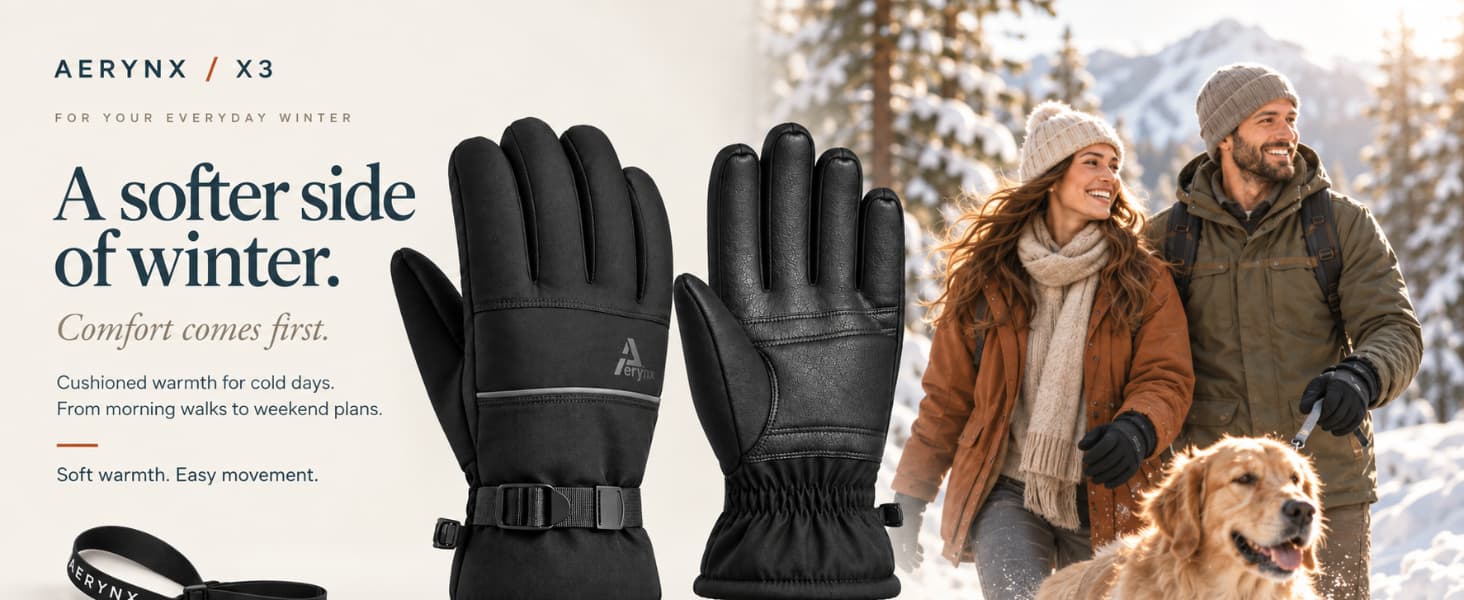
For colder, longer walks, the Aerynx X3 Winter has a six-layer construction, pre-curved fingers shaped toward a natural curled-hand grip (more on that in our explainer on pre-curved glove fingers), a padded microfiber PU synthetic-leather palm, a ten-finger touchscreen, a thumb wipe panel, a long cuff with a wrist adjuster, a pairing clip and a detachable wrist leash for the glove itself, useful when you pull one off to tie a bag. It is not genuine leather, it has no published temperature rating, it is not for soaking, and it is not a cut- or bite-resistant work glove. Its extra bulk is the tradeoff: run the bag-and-knot test before you rely on it.
Dog-walking glove questions
Common questions
- Will grippy gloves stop my dog from pulling the leash out of my hand?
- Not reliably. A textured palm helps with an ordinary hold, but a sudden lunge can still pull the leash through your fingers. Hold the handle rather than wrapping the leash around your hand, keep larger dogs on a shorter lead, and work on loose-leash walking.
- How do I open a waste bag with gloves on?
- Close-fitting fingertips make the biggest difference. Rub the bag between thumb and index finger to find the edge, or choose bags with tie handles, which are easier to open and knot. If you have to take a glove off, keep it where it will not fall into slush and put it back on straight away.
- Do I need waterproof gloves for walking the dog?
- Not automatically. For regular rain or wet snow, a glove with a waterproof barrier may be a reasonable starting point; for a wet leash, snowball or slush, pressure and cuff and seam design still matter. Water-repellent gloves can suit light moisture. For actual immersion, use gear whose manufacturer confirms it for that task, and keep a dry spare. Our guide to waterproof vs water-resistant gloves explains the difference.
- How do I stop losing a glove on the walk?
- Use one pocket for gloves every time, and consider a glove with a wrist leash or a pairing clip. Our guide to keeping track of winter gloves covers more habits.