The short answer
You pull off a glove to pay at a market stall or grab a quick photo, pin it under your arm, and by the time you reach the car there's only one. Most lost gloves go missing in the minute after they come off, not while they're on your hands.
So if you want to stop losing winter gloves, match the fix to the moment. A wrist leash keeps a removed glove attached to you during short bare-hand tasks. A pairing clip keeps the two gloves together once both are off, in a pocket, bag or cubby. A fixed storage habit covers everything else and needs no hardware at all. For children, skip adult-style leashes and long strings, and use short clips, name labels and one fixed spot instead.
Where gloves actually go missing
Think back to the last glove you lost. It probably disappeared after one of three moves:
- A quick bare-hand task outdoors: a photo, a phone call, paying, digging for keys. The glove goes under an arm, into your teeth or onto a bench.
- Helping someone else: zipping a child's coat, clipping on a dog's leash, handing over a bag. Your gloves land on the car roof or the stroller canopy.
- Arriving somewhere: both gloves come off together, go into whichever pocket is closest and fall out later when you pull out your phone.
Each moment needs a different fix, which is why no single accessory solves everything. A lost glove can also be more than an annoyance. Writing about winter mountain days, Mountaineering Scotland notes that most winter gloves and mitts have wrist loops but that losing one could have serious consequences, and it advises packing at least one spare pair (Mountaineering Scotland's winter night-out advice). A city walk is lower stakes, but the same logic applies: keep gloves attached when you need to, and carry a backup when the day is long or wet.
Wrist leash vs pairing clip: different jobs
The two attachments are easy to confuse because both keep gloves from wandering off. They work at different moments:
| Tool | Best moment | What it does | Limits |
|---|---|---|---|
| Wrist leash (adult) | Short bare-hand tasks: photos, phone, paying | Keeps a removed glove hanging from your wrist | Can snag or swing near moving parts; not a spare pair; not for young children |
| Pairing clip | After both gloves come off | Holds the two gloves together in a pocket, bag or cubby | Doesn't keep a glove attached to you while you work; only helps if you clip every time |
| Fixed storage spot | Every time, for everyone | One pocket or bag spot that is always the glove spot | Takes repetition before it's automatic |
| Spare pair | When a glove is lost or wet anyway | Keeps your hands covered for the rest of the outing | A little extra bulk in your bag |
None of these tools is unique to one brand. The product page for Outdoor Research's Arete Modular GORE-TEX Glove (style 322162), for example, lists removable leashes and a glove clip (checked September 2026) (Outdoor Research Arete Modular glove). When you compare gloves, look at how an attachment connects and which moment it's for, not just whether it's there.
A storage habit that works without any hardware
Accessories help, but the habit does most of the work. Pick the steps that fit your day:
- Choose one glove pocket, ideally zippered or inside your jacket, and use it every time instead of rotating between pockets.
- Glove in the pocket before the phone comes out, so taking it off and putting it away become one motion.
- Never set a glove down outdoors: not on a car roof, bench, stroller canopy or café table.
- Before you walk away from anywhere you took gloves off, count two.
- Clip or pair gloves before they go into a bag, so you never pull out just one.
- At home, keep one basket or hook by the door for dry gloves. Wet ones go somewhere to dry first; our guide to drying winter gloves inside covers that.
If you take gloves off constantly for a camera or phone, the bigger fix may be fewer removals. Our notes on keeping hands warm for winter photography look at that problem directly.
Using an adult wrist leash well
A wrist leash is simple, but a few habits make it more useful and less of a nuisance:
- Attach it the way the glove's instructions describe, and check the connection at the start of each outing.
- Set the wrist loop so it can't slide off over your hand, while staying comfortable rather than tight.
- Think about where the dangling glove goes. Around bike wheels, machinery, a dog's leash or closing doors, put the glove in a pocket instead of letting it swing.
- Take the leash off when it gets in the way of a task; it's a convenience, not a rule.
- Keep a spare pair anyway. A leash reduces losses, but it won't keep a glove dry or stop it going missing when it isn't attached.
On a longer winter outing that spare matters more; see why to pack spare gloves for a short winter hike.
Why kids need a different setup
It's tempting to borrow the adult solution for kids, or to go old-school with a long string threaded through both coat sleeves. The Canadian Paediatric Society recommends mitten clips instead of a string to prevent choking, along with a neck warmer instead of a scarf and removing drawstrings that can catch on equipment (Canadian Paediatric Society winter safety advice).
That advice is about strings and cords in general rather than glove leashes specifically, so treat the next point as a cautious suggestion rather than a medical rule: don't move an adult wrist leash onto a young child's glove, and don't improvise longer cords, especially anything that loops around the neck or runs through both sleeves. The setup that fits the pediatric advice is simpler:
- Short mitten clips that keep each glove or mitten with the coat, or a pairing clip that keeps the two together.
- Your child's name written inside both gloves.
- One fixed pocket or backpack spot, practiced at home before school starts.
- A spare pair in the backpack, and any school rules on clips and cords followed.
Our school glove guide includes a try-on where your child practices putting gloves away, not just putting them on.
What to check before you buy, and where Aerynx fits
When a glove comes with attachments, ask three questions: is it removable, how does it connect, and which moment is it for, in use or in storage? An attachment you'll never use doesn't make a better glove. One that fits the way you actually take gloves off does.
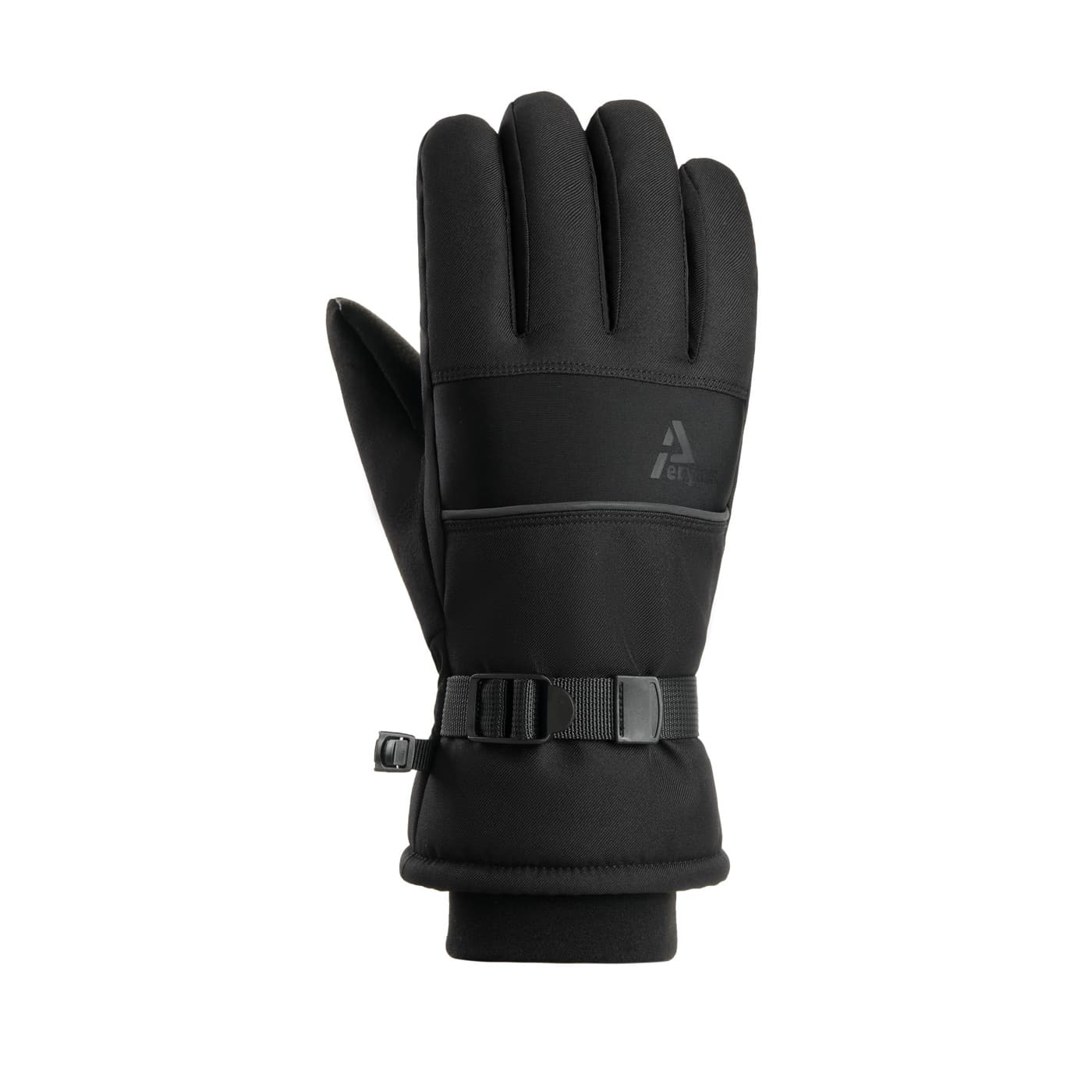
Our Aerynx X3 Winter is the Aerynx glove designed around those take-it-off moments. It comes with a detachable wrist leash for short bare-hand tasks and a pairing clip for storage, along with a wrist adjuster and a long cuff. Its ten-finger touchscreen design can also mean fewer reasons to pull a glove off for a quick tap, though response still depends on your device, your screen protector and whether your fingertips are wet. X3 has no published temperature rating, and it isn't made for soaking; seams can let water in.
For kids, the attachment on Aerynx X0 Kids is a pairing clip for keeping both gloves together in a pocket or cubby, and we don't suggest adding an adult-style wrist leash to it. We haven't published a verified hand-size chart or age table for X0, so measure your child's hand and check the size guidance on the product page before ordering.
Glove-keeping questions
Glove-keeping questions
- Can a wrist leash replace a spare pair of gloves?
- No. A leash keeps a removed glove close, but gloves still get wet, and they still go missing when the leash isn't attached. Mountaineering Scotland advises carrying at least one spare pair in the mountains; on everyday outings a spare still turns a problem into a quick swap.
- Can I use a pairing clip to hang gloves from my wrist?
- That isn't what it's for. A pairing clip keeps two gloves together once they're off, in a pocket, bag or cubby. If you want a glove attached to you during bare-hand tasks, use a wrist leash designed for that job.
- Is it OK to connect kids' mittens with a long string?
- The Canadian Paediatric Society recommends mitten clips instead of a string to prevent choking. Short clips, name labels and a fixed storage spot are a better way to keep a child's pair together, and school rules on cords should be followed too.