The short answer
It is 7:50 a.m., the bus is two stops away, and your child is at the door with one glove inside out and the other lost in a backpack. Nobody cares how warm the label says the gloves are. What matters is whether your kid can get them on, off and back in the same place without an adult.
So choose winter gloves for school kids in this order: a size that fits your child's hand now, a design they can put on and take off by themselves while wearing their real winter coat, a cuff that overlaps the sleeve, a dry backup pair, and a simple way to keep the two gloves together. Warmth comes next, and it depends on the weather, how long recess runs and whether the gloves stay dry. If five separate fingers are still a struggle, mittens may be the better school choice this winter.
What a school glove has to handle in one day
Picture the day from the glove's side. It goes on at the door, grips backpack straps and a bus handrail, comes off in a hallway, sits in a cubby for hours, goes back on for recess, gets packed with snow and has to be found at dismissal. Most glove problems at school show up at one of those handoffs, not on a thermometer.
The American Academy of Pediatrics lists mittens or gloves among the winter essentials alongside insulated boots and a hat, recommends several thin layers, and says children should change out of wet clothes right away (AAP guidance on playing outside in winter). At school, that last point turns into two practical questions: can your child tell an adult when the gloves are wet, and is there a dry pair to change into?
Gloves or mittens for school: judge the skill, not the age
The Canadian Paediatric Society suggests mittens for children because fingers bunched together stay warmer (Canadian Paediatric Society winter safety advice). Five-finger gloves earn their place when a child needs to grip, zip and handle small things, but only if the child can actually get each finger into the right slot.
No birthday makes that suddenly easy, so watch your own kid rather than a chart. Signs a child is ready for five-finger school gloves:
- They get both gloves on without help, with each finger in its compartment and no pinching or awkward empty space.
- They can take the gloves off and tuck both into the same pocket without dropping one.
- They can still hold a backpack strap and open a lunch container while wearing them.
- They don't give up and go bare-handed because putting the gloves on takes too long.
If most of those don't happen yet, choose mittens for school and try gloves again later. Our gloves vs mittens comparison covers the wider trade-off between warmth and dexterity.
Why a size up for next winter usually backfires
Buying big so the gloves last two seasons is tempting. The catch is that extra fingertip length makes the finger slots harder to find, makes gripping clumsier and lets the glove slide off during play, and a loose cuff can leave a bare wrist when your child reaches up. A glove that fits the hand your child has today is more likely to stay on.
Measure instead of guessing. A common method is to wrap a soft tape around the hand just below the knuckles, not including the thumb; a piece of string and a ruler work if you don't have a tape (Hestra's glove size and fit guide). Hestra also notes that its children's and junior sizes follow a separate scale from its adult sizes, so a size on one chart doesn't carry over to another. Age labels, where a brand uses them, are a rough starting point, because children the same age can have noticeably different hands.
Note hand length too, from the wrist crease to the tip of the middle finger, and compare both numbers with the size guidance for the specific glove. Our glove sizing guide explains measuring for adult gloves; don't apply an adult size table to a child. If you are unsure, ask the brand before ordering.
A school-day try-on at home
Do this once before the first cold morning, with your child doing every step and you only watching. Use the actual winter coat and backpack they will wear to school.
| Check | How to test | It passes when | If it fails |
|---|---|---|---|
| On alone | Coat on, then gloves on with no help | Each finger sits in its compartment with modest clearance, the thumb is in the thumb, and nothing pinches | Try a closer size, a different cut or mittens |
| Off and away | Take both gloves off and put them in the chosen pocket or backpack spot | Both gloves end up in the same place | Pick an easier pocket, or clip the pair together |
| Grip | Zip the backpack, hold a water bottle, open a lunch container | They manage without pulling a glove off | The gloves may be too big or too stiff for these hands |
| Reach | Raise both arms as if climbing a play structure | No bare wrist shows between cuff and sleeve | Try the cuff over or under the sleeve, or a longer cuff |
If one check fails, fix that problem first. A warmer glove won't help a child who leaves it in the cubby because it takes too long to put on.
Plan for wet gloves and teach the words for help
Snow at recess means wet gloves by lunchtime for plenty of kids. Pack a dry backup pair in a labeled zip bag inside the backpack, plus an empty bag to bring the wet pair home, and let the wet pair dry fully at home before the next morning. For weekend sledding and snow forts, see checks and dry-glove swaps for snow play.
Kids also need simple words and clear permission to speak up. Practice four short phrases: my gloves are wet, my hands hurt, my fingers feel numb, I can't hold things. Any of those is a reason to find a teacher or recess aide right away, not something to push through.
Keep the pair together: names, clips and one fixed spot
Three habits cut down on lost gloves: write your child's name inside both gloves, choose one pocket or backpack spot that is always the glove spot, and clip the pair together whenever they come off.
Skip long strings threaded through coat sleeves or around the neck. The Canadian Paediatric Society recommends mitten clips instead of a string to prevent choking, and a neck warmer instead of a scarf. Follow any school rules on clips and cords as well. We go deeper on leashes, clips and storage habits in how to stop losing winter gloves.
What a kids' glove should tell you, and where X0 Kids fits
Before buying any kids' glove, look for four things on the product page: size guidance that explains how to measure, a plain description of the construction, care instructions, and stated limits.
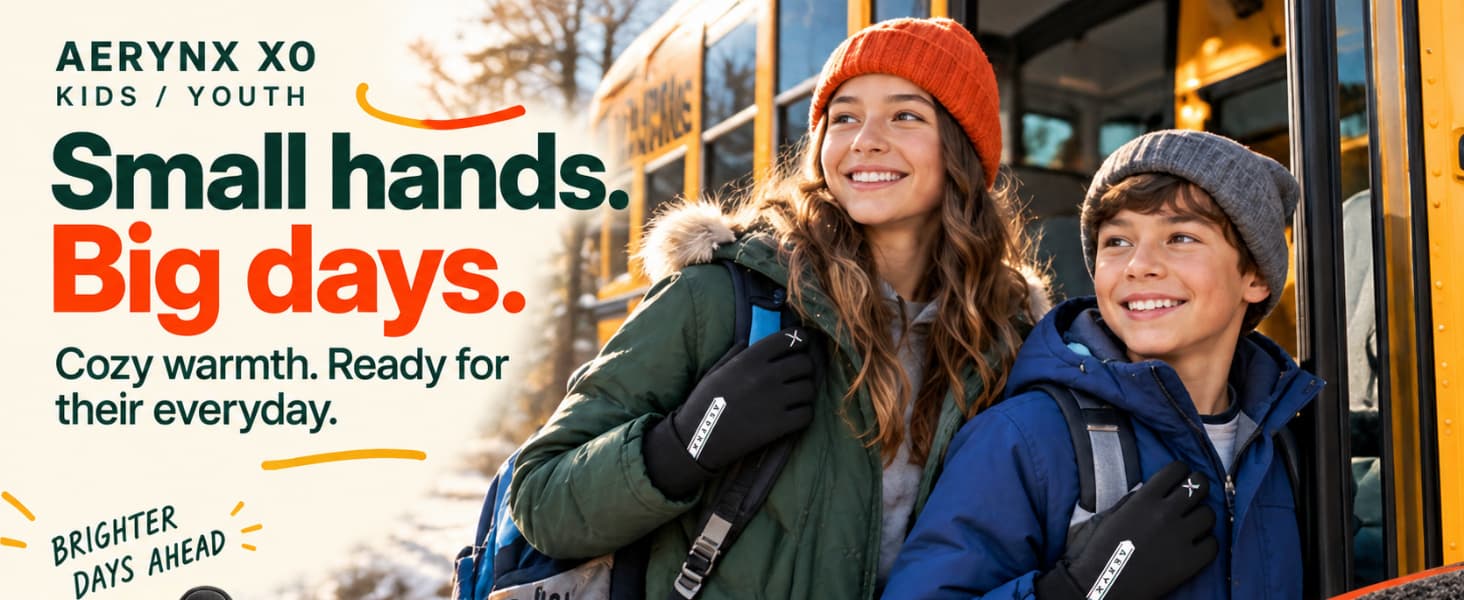
Our Aerynx X0 Kids glove is designed around these school-day tasks. It has a nylon shell over a membrane with a graphene-fiber fleece lining, silicone grip dots on the palm for straps and bottles, a long cuff to overlap coat sleeves, and a pairing clip to keep both gloves together in a cubby or pocket. Three fingertips work on touchscreens, which is a convenience for a quick message at pickup rather than a reason to use a phone while walking.
Know the limits before you order. We have not published a verified hand-size chart, an age-to-size table or a temperature rating for X0, so measure your child's hand, check the size guidance on the product page, and contact support if you are unsure. Don't assume it suits a toddler or preschooler just because it is a kids' glove; the try-on is the real test. X0 is not made for soaking, and water can still get in at the seams and cuff, so pack the backup pair. The iridescent logo is decorative, not reflective, so dark bus-stop mornings still call for proper reflective gear. And if mittens passed your try-on while gloves didn't, choose mittens: X0 is a five-finger glove.
School glove questions
School glove questions
- Should I buy school gloves a size up so they last another year?
- Usually not. Extra fingertip room makes gloves harder to put on and grip with, and loose gloves slip off during play. Buy for the hand your child has now and measure again next fall.
- My child can't get their fingers into gloves. What should I do?
- Check the size first, because gloves that are too big are hard to fill. If fit isn't the problem, send mittens to school and practice gloves at home on relaxed weekend mornings until the skill comes.
- Do kids need touchscreen gloves for school?
- No. Touchscreen fingertips are a convenience for kids who carry a phone. Fit, easy on and off, and a dry backup matter more. If your child does use a phone, remind them to stop walking before they tap.