The short answer
Ten minutes of brisk walking to the station, six minutes on an open platform with wind coming down the tracks, then twenty-five minutes on a train heated like a living room. The gloves that felt right on the platform are clammy by the third stop, and when you step back outside, your hands are colder than when you left home.
For most transit commutes, the best winter commuting gloves are a mid-weight, wind-blocking pair that is easy to pull off and put back on, with touchscreen fingertips for the tasks you cannot avoid. Take them off when the carriage warms you up, keep them in the same pocket every trip, and put them on again before the doors open. Go warmer only if your outdoor legs are long, windy, wet or spent mostly standing still.
Why one commute needs two kinds of warmth
A commute is not one temperature. Walking to the stop generates heat. Standing on a platform does not, and wind strips warmth from anything exposed. Then a crowded train or bus asks for almost no insulation at all. REI describes layering as a way to regulate comfort by slipping layers on and off as activity or weather changes, and gloves are the easiest layer to adjust.
The mistake is treating gloves as fixed. Canada's occupational health agency, CCOHS, advises taking layers off before you get warm enough to sweat, with gloves among the first things to remove, and letting clothing air out when you are somewhere warm, because damp clothing insulates far less. That guidance is written for outdoor workers, but the logic fits a heated carriage: hands that sweat inside gloves on the train tend to feel colder on the walk home.
| Leg | What your hands feel | What to do | What the glove needs |
|---|---|---|---|
| Walk to the stop | Warm quickly if you walk fast; wind on the backs of the hands | Gloves on before you leave | Wind-blocking back, a cuff that meets your sleeve |
| Platform or bus-stop wait | The coldest part: still, exposed, often windy | Stand out of the wind; keep gloved hands in pockets | Enough insulation for your longest usual wait |
| Warm train or bus | Warm, then damp if gloves stay on | Take gloves off once you feel warm; stash them in one pocket | Easy to remove and pull back on |
| Exit and final walk | Cold air on hands that may be slightly damp | Put gloves back on a stop early | A lining that feels comfortable going back on |
On the train: keep them on or take them off?
Take them off once your hands feel warm, not when they already feel sticky. A short ride with the doors opening onto cold platforms may be fine with gloves on; a long, heated ride usually is not. If you need a hand free for your phone while holding a pole, pull off one glove and keep the other on.
- Use the same pocket for gloves every time. It makes them faster to find and harder to leave on a seat. Our guide to keeping track of winter gloves has more habits.
- Avoid stuffing damp gloves into a sealed bag pocket for the whole day; a coat pocket or an open tote lets them air out a little.
- Put them back on one stop before yours, so you are not fumbling with cuffs while stepping onto a cold platform.
- If the carriage is cold or the ride is short, leave them on and loosen the cuff instead.
The platform is the hardest part of the commute
It is easy to choose gloves for the walk, but the wait decides whether they were warm enough. Standing still, you produce far less heat than you did walking briskly, and wind on an open platform carries it away. Stand behind a shelter wall or a pillar if you can, keep gloved hands in your pockets, and move a little rather than standing rigid.
Do the fiddly phone work indoors. Load your ticket, check delays and pull up the map before you leave the building, so you are not taking gloves off on the platform to type. Your phone has limits of its own: Apple lists a normal ambient operating range of 32–95°F (0–35°C) and notes that cold can temporarily shorten battery life or even turn the device off. Touchscreen gloves let you use the phone; they do not change what the phone can tolerate. Keep it in an inside pocket between uses.
Tickets, maps and keys: what a commuting glove has to do
Split the tasks. Tapping a transit card or phone on a gate reader does not depend on the glove at all. Scrolling a map, typing a message or confirming a payment does, and results vary by device. Samsung, for example, offers a Touch sensitivity setting for gloves and screen protectors on some Galaxy models, and warns that a wet screen may not respond properly. Ticket machines and kiosk screens differ again, so do not assume that a glove that works on your phone will work on every screen in the station.
- Test at home with your own phone, case and screen protector: unlock, scroll a map, type a short message.
- Check which fingertips are conductive and practice using those, rather than the fingertip you use bare-handed.
- Grip matters too: a textured palm helps with a handrail, a coffee cup and a phone held one-handed.
- Keys and zipper pulls are a task test. If you cannot pull keys from a pocket with gloves on, check for bulk or stiffness, pocket access, poor fit in either direction, and the size of the key itself.
If a touchscreen glove stops responding, check fit, moisture and the screen setup before blaming the glove. Our guide to why touchscreen gloves stop working walks through the checks.
The one-minute routine that makes tomorrow easier
When you get home or to work, take the gloves out of your bag or pocket, open the cuffs and leave them somewhere with air around them, away from direct heat. A pair that sat damp and folded all day starts tomorrow's commute already cold. Our guide to drying winter gloves inside and out covers the method in detail. Then put them together in one place by the door, so the morning version of you is not searching for the second glove.
What to look for in one everyday commuting glove
Most commuters need one glove, not two. Prioritize, in order: a fit close enough for keys and a phone; a wind-blocking back; a cuff that is easy to pull on and overlaps your sleeve; touchscreen fingertips in the places you actually tap; and weather protection matched to how often your walk is wet. Our guide to choosing gloves by temperature helps with the warmth side.
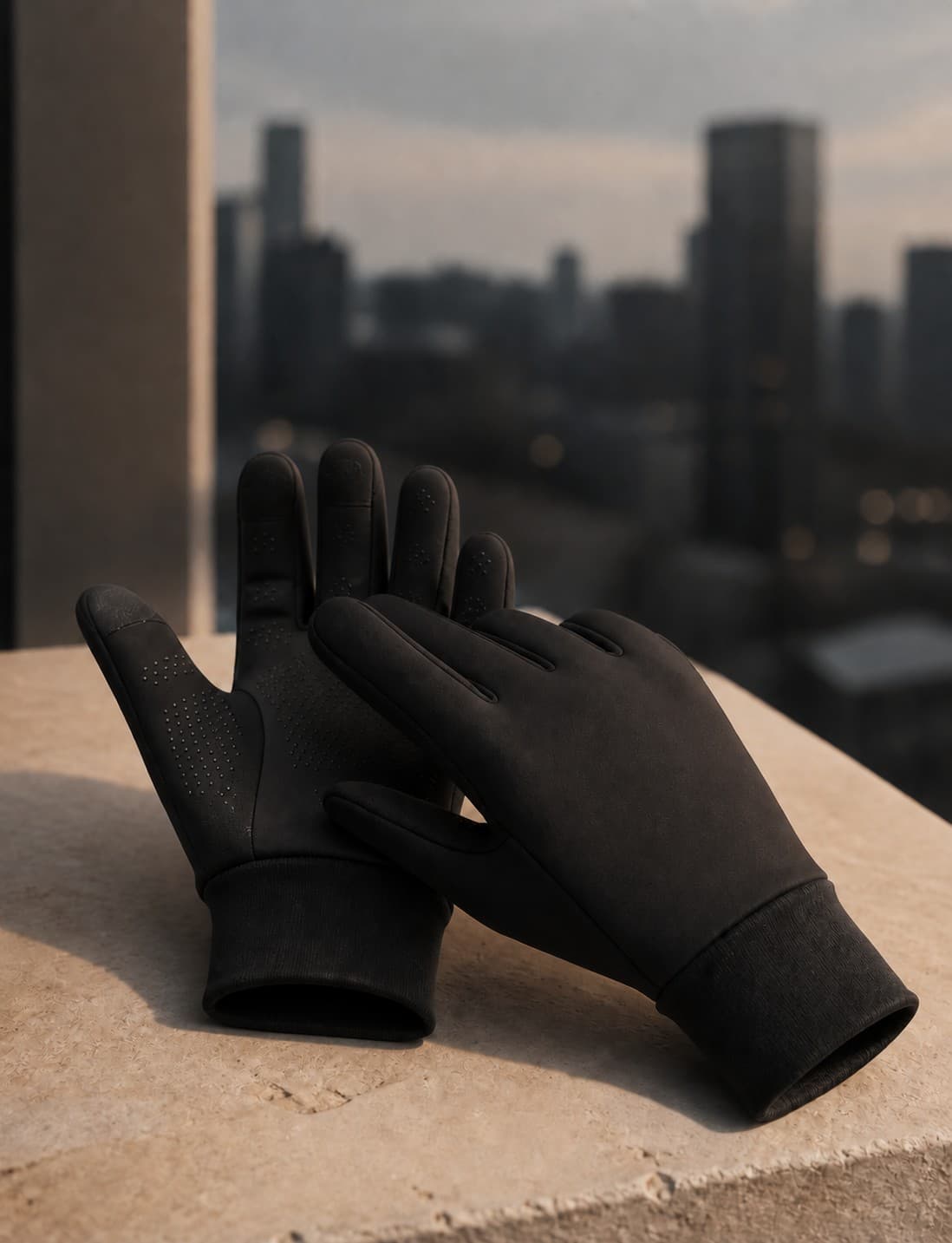
The Aerynx X2 Daily is our everyday glove for this kind of day. It has a three-layer build: a waterproof soft-touch shell, a wind-blocking mid-layer and a graphene-fiber fleece lining. It adds a three-finger touchscreen, a silicone palm grip, an extended cuff and a reflective back-of-hand detail, which is a small extra for dark evening walks, not a replacement for a light or reflective outerwear. Our use guidance for wearing it on its own is 32–50°F (0–10°C); treat that as brand guidance, not a safety rating, because wind, wet and a long platform wait will shift it. We define the X2 as waterproof, and it suits rain and wet-snow commutes, but it is built for wet-weather wear, not for soaking or submersion; water can still find a way in at the seams and the cuff.
If your commute is mostly indoors or the weather is milder, the Aerynx X1 Lite is the lighter choice: a four-way-stretch glove with 320 gsm fleece, touchscreen thumb, index and middle fingertips, a silicone palm grip and a water-repellent finish. It is not waterproof, and our 41–59°F (5–15°C) guidance for solo wear is brand guidance too. Our X1 vs X2 comparison covers the tradeoff in more detail.
Commuting glove questions
Common questions
- Should I take my gloves off on the subway or bus?
- On a warm, longer ride, usually yes. Taking them off before your hands start to sweat keeps the lining drier, so the gloves feel warmer when you step back outside. On short or cold rides, leaving them on is fine.
- Will touchscreen gloves work on every ticket machine?
- Not necessarily. Screens differ, and results also depend on glove fit, moisture and the fingertip you use. Tapping a card or phone on a contactless reader does not depend on the glove. Test your own devices before relying on them.
- Is one thin pair of gloves enough for a daily commute?
- It can be, if your outdoor legs are short and the weather is mild. If you wait on exposed platforms, walk far, or commute in rain and wind, a wind-blocking mid-weight glove is the better single pair.