The short answer: worth it when it has a clear job
You pull off your insulated gloves at the bus stop to answer a message, and by the time you've typed two lines your fingers sting. A thin liner looks like the obvious fix. Then a windy walk home in that liner alone leaves you wondering why anyone buys them.
Glove liners are worth it when you know which job you want them to do. Under a warmer outer glove, a liner adds an inner layer and lets you take the outer glove off for a quick task without going bare-handed. On a mild or high-effort day, some liners work as a light glove on their own. What a thin knit glove won't do is stand in for a weather shell in steady rain, wet snow or long periods of standing still in the cold.
What a thin liner does, and what it doesn't
Outfitters describe liners mainly as a layering tool. REI's gloves and mittens buying guide says pairing a lightweight liner glove with an outer shell offers versatility and customization, notes that some liners can be used alone on days when you don't need the added warmth of an outer shell, and suggests a liner under a waterproof outer mitten so you can take the mitten off for a fiddly task and still keep your hands covered.
Cold-weather guidance makes the same point about layers in general. Canada's Centre for Occupational Health and Safety (CCOHS) recommends multiple layers over a single thick garment, notes that the air between layers adds insulation, and says the inner layer should help move moisture away from the skin. The same guidance warns that an outer layer that is too small compresses the layers underneath and reduces their insulation, which matters the moment a liner goes inside a snug glove.
| Job | What the liner adds | What it still needs |
|---|---|---|
| Inner layer under a warmer glove or mitten | A close, removable contact layer and a little extra insulation | An outer glove with enough room that the liner isn't squeezed |
| Buffer for quick tasks | Covered fingers while the outer glove is off for keys, zippers or a phone | Touchscreen fingertips if you want to use a phone, and a pocket or clip for the outer glove |
| Solo glove on mild or active days | Light warmth with good dexterity | A realistic forecast: wind, rain, standing still and long exposure all push it past its limits |
Notice what's missing from that table: weather protection. Most knit liners are built for fit and dexterity, not to block steady wind or keep out rain. Some carry a water-repellent finish that helps light moisture bead up, which is different from a waterproof barrier. If the outing is wet, the protection has to come from the outer layer.
Why some people decide liners are useless
When a liner disappoints, it's usually been asked to do a job it was never matched to. Three patterns come up again and again.
- It was worn alone in the wrong conditions. A thin glove that feels fine on a brisk walk can feel inadequate at a windy bus stop on the same morning, because standing still and moving air both change how quickly hands cool.
- It got damp. Sweat from a fast walk, or snow melting into the fabric, turns a liner from an insulator into something that keeps drawing heat from your fingers. CCOHS is blunt that clothing must stay dry to insulate well.
- It was squeezed. A liner pushed into an outer glove with no spare room compresses both layers. If the combination feels snug before you even make a fist, the pairing is the problem, not the idea of a liner.
None of this means liners are pointless. It means a liner has to be matched to the weather, kept reasonably dry and paired with an outer glove that has room for it.
Do thin gloves work with touchscreens?
Some do, some don't, and thickness doesn't tell you which. The brand's product page for the Smartwool Liner Glove lists a touchscreen-compatible thumb and index finger and says the glove can be worn on its own or under another pair of gloves or mittens. The product page for the Outdoor Research Vigor Lightweight Sensor Glove lists touchscreen compatibility, a silicone print grip on the palm and a non-waterproof build meant for moderate temperatures or high-output use. Both pages were checked in September 2026. So the idea that thin gloves never work with phones is simply wrong for those models.
The reverse holds too. A liner page that doesn't mention touchscreen fingertips hasn't proved the glove lacks them, but you can't count on the feature either. Read which fingers are listed and on which hands, then test with your own phone. Fit matters as much as fabric: a loose fingertip that folds over the pad of your finger registers unreliably, and screen protectors, cold screens and wet fingertips can all interfere. Why touchscreen gloves stop working walks through those failures one by one.
How to compare liners side by side
Product pages rarely line up neatly, so compare the same six things for every liner you're considering. If a page doesn't mention an item, write "not stated" rather than assuming the feature is missing, and ask the brand before you buy.
| Check | What to look for | Why it matters |
|---|---|---|
| Material and weight | Fiber type (merino, polyester fleece, stretch knit) and any stated fabric weight | Tells you roughly how much bulk goes inside your outer glove |
| Fit | Close through the fingers and palm without pulling across the knuckles | Too loose bunches under a shell; too tight compresses insulation |
| Touchscreen fingertips | Which fingers are listed, and whether both hands have them | One fingertip can tap; a thumb helps with one-handed use |
| Palm grip | Silicone print or dots, and where they sit | Helps hold a phone, leash or handlebar with the outer glove off |
| Weather statement | Water-repellent, wind-resistant or nothing stated | Sets expectations for solo use; a liner is rarely a rain layer |
| Care | Washing and drying instructions | Liners get sweaty first and need washing most often |
How to test a liner with the gloves you already own
The only reliable test is the combination you'll actually wear. Before you commit, run through this sequence.
- Decide the main job first: solo glove, inner layer or quick-task buffer. It changes which features matter.
- Check touchscreen, grip and weather statements separately. A glove can have one without the others.
- Put the liner on, then your outer glove, and make a firm fist. If the fingertips press against the ends or the knuckles feel tight, the outer glove doesn't have room.
- Do a real phone task with the outer glove off: unlock, type a short message and zoom a map. Waking the screen isn't a test.
- Pull the outer glove off and check whether the liner stays in place. If it keeps coming out, the fixes in how to layer gloves are worth trying before you give up on the pair.
- For steady wet cold, choose an outer layer whose product page clearly states the protection you need, rather than relying on the liner.
Sizing matters more than usual when two gloves have to work together. Measure your hand and check each brand's own size guidance; our glove sizing guide explains how we weigh touchscreen precision against room for layering.
When a more complete liner makes sense
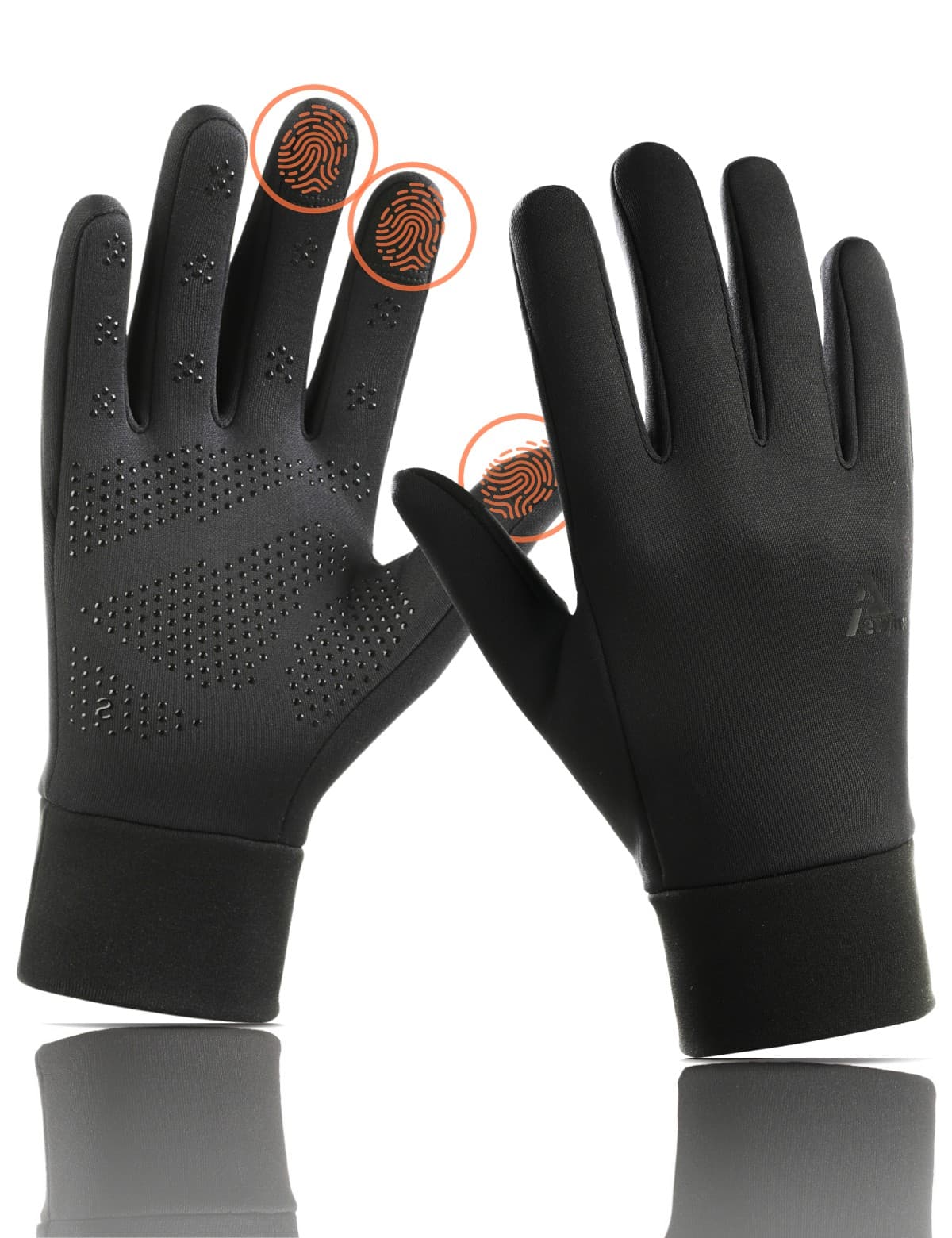
If your days mix short commutes, dog walks and phone use, it can make sense to choose a liner that covers several of those needs at once rather than the thinnest possible glove. That's the idea behind the Aerynx X1 Lite: a four-way stretch shell with a 320 gsm fleece interior, touchscreen thumb, index and middle fingertips on both hands, a silicone palm grip, an extended stretch cuff and a water-repellent finish. We state that no PFAS are intentionally added to any part of the glove.
Its limits matter just as much. X1 Lite is water-repellent, not waterproof, so steady rain calls for a shell. Our 41–59°F (5–15°C) figure is brand use guidance for wearing it on its own, not a safety rating; wind, wet weather, effort, time outside and your own circulation all change how it feels. And because 320 gsm fleece isn't the thinnest liner category, check that your outer glove has room for it before relying on the pair. We don't promise it fits inside any particular shell.
If you already own a thin liner you like, you may not need another. And if most of your cold time is spent standing still, a warmer insulated glove or a mitten may do more than any liner; gloves versus mittens for everyday winter covers that trade-off.
Liner questions
Quick answers
- Are glove liners waterproof?
- Usually not. Most liners are knit gloves built for fit and dexterity. Some have a water-repellent finish that helps light moisture bead up, but for steady rain or wet snow the protection has to come from an outer glove or shell.
- Do all wool or fleece liners work with touchscreens?
- No. Some list touchscreen fingertips, such as the thumb and index finger on the Smartwool Liner Glove, while others don't mention the feature. Check which fingers the product page lists and test with your own phone.
- Can a liner be my only winter glove?
- On mild days or during higher-effort activity, a liner may be enough on its own. For wind, wet weather, long exposure or standing still, pair it with an outer glove or choose a warmer insulated glove or mitten.