The short answer
You leave home at 41°F (5°C), feel fine walking to the bike, and then your fingers start aching before the first traffic light. The forecast has not changed, but your hands are now meeting moving air, a fixed handlebar grip, and a task that keeps them in one position. That is why cold hands cycling in winter often feels different from the same walk.
Start by solving the job in this order: block the air reaching the back of your hands and wrists, keep enough room to close your fingers around the bars, check every brake and shift movement while parked, and manage sweat before it becomes a cold inner layer. A thicker glove is useful only when it still lets you control the bicycle. If your fingers become numb, painful, discolored, or too clumsy to brake reliably, stop in a safe place and get warm rather than trying to ride through it. The CDC frostbite guidance treats numbness, unusual color, redness, and pain as reasons to leave the cold and protect the area.
Why the same temperature feels colder on a bike
A walker creates less relative airflow at the hand. A cyclist moves through air continuously, and the exposed side of the glove has less time to recover between gusts. The National Weather Service explanation of wind chill describes wind chill as a model of heat loss from wind and cold on exposed skin. Use that idea to notice why a headwind, descent, or open bridge feels harsher, but do not turn it into a glove temperature rating.
Do not add your bicycle speed to the weather-app wind speed and call the total a new wind-chill number. The NWS index has defined inputs and assumptions; your route also has shelter, sunlight, traffic stops, hills, and changes in hand position. The practical question is simpler: which parts of the ride put your hands directly in moving air, and which parts keep them still against a cold grip?
Check wind protection before adding bulk
If the cold arrives mainly on a fast, exposed section, look at the layer facing the air before reaching for the thickest insulation. A wind-resistant outer surface or a shell can change the job of the layers underneath. If the problem is a long stop, low effort, or wet snow, you may need more insulation or a dry replacement instead. These are different problems that happen to produce the same complaint: cold fingers.
Cycling UK’s cold-weather clothing guide treats layering as a way to handle changing conditions and exertion, and its hand advice favors full-finger coverage with grip where your hands meet the controls. That is a useful standard for a daily bicycle: coverage must survive the moving air, but the palm must still let you feel and hold the bar.
| When it feels cold | Check first | Practical adjustment | Do not assume |
|---|---|---|---|
| Within the first exposed stretch | Back of hand, wrist and cuff gap | Improve wind coverage and sleeve overlap | That more insulation is automatically the answer |
| Only after a hard effort | Damp palm, lining and how long you stop | Vent or reduce a layer before the glove is soaked | That the shell is failing just because sweat is inside |
| Mostly at traffic lights | How long you are motionless and whether the glove is dry | Use a route with warm stops or carry a dry option | That a short active rating covers a long stationary wait |
| When gripping the bar | Finger bend, seams and pressure points | Try the size and layer on the actual bars | That a glove fitting an open hand fits a riding hand |
A bicycle fit check is different from a standing try-on
Put on the gloves you plan to ride in, then sit on the bicycle in a safe, stationary place. Use your normal hand position rather than holding the bar with a flat palm. The purpose is not to imitate a ride for a few seconds; it is to find a pressure point before the road makes the decision for you.
- Close both hands around the grips with your wrists in their normal riding angle. Check that the fingertips reach the ends without pulling the glove backward.
- Cover and release each brake lever several times. You should be able to feel the lever, pull it with the intended fingers, and release it without the glove catching.
- Operate every shifter or button you actually use. If a thumb or index finger has to stretch, slide, or bunch fabric to reach it, test another size or construction.
- Rotate your wrists as if climbing, turning, or riding over a rough patch. Watch for a cuff that rides up and exposes the wrist or a palm that folds under the bar.
- Open and close your hands after the control check. If the fingertips tingle or the palm feels compressed, remove a liner or change the size before you add warmth.
A glove sizing check is a starting point, not a substitute for this test. If your riding glove will sit over a liner, do the whole check with both layers on. A pair that fits alone may become restrictive when the liner takes up the space you need to curl your fingers.
When a liner helps, and when it makes riding worse
Thin liners are not useless just because they are thin. Some support touchscreens, and a liner can add a dry, close layer under a shell or make a light glove more adaptable on a mild ride. The fair test is whether it solves a specific gap: a little extra coverage, a better next-to-skin feel, or a layer you can remove when your hands heat up.
The limit is space. Two gloves can press the fingers, flatten the insulating air space, make the fingertips miss the brake lever, or trap sweat between layers. Put the liner on before you choose a size, then make the same brake, shift, grip, and wrist checks. If the setup is tight, a single wind-blocking glove may be safer and more comfortable than two thinner pieces.
For a more general comparison of what liners do and do not add, see are glove liners worth it. For cycling, keep the conclusion local to your hands: if the palm is damp, take the safest opportunity to adjust; if the fingers are losing control, end the exposure. Never remove both gloves while moving or reach for a phone from the saddle. Pull over where you are visible and stable.
Choosing a daily cycling glove
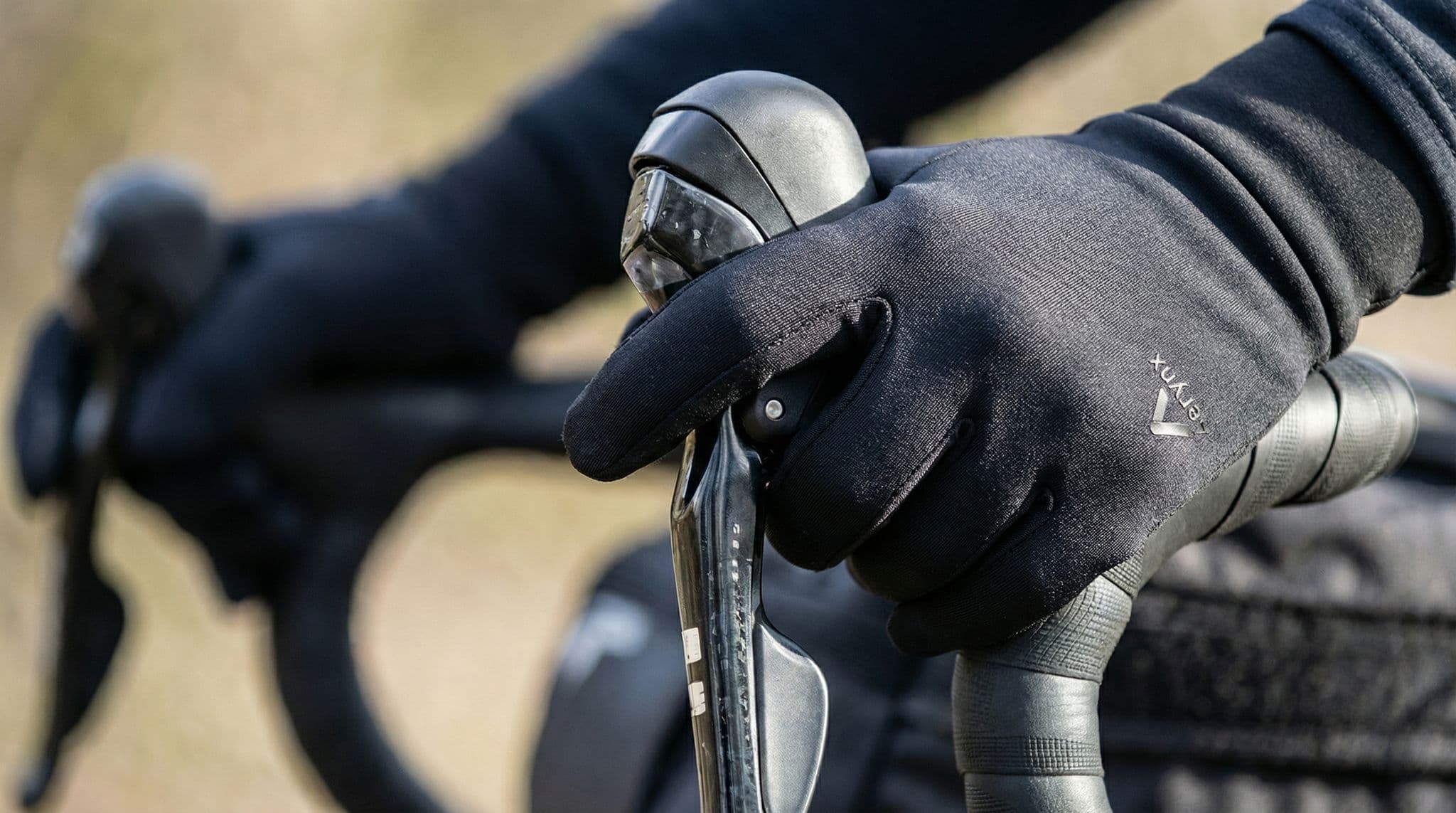
If moving air is the main problem and you want one glove to consider for a wet-weather commute, the 2026 Aerynx X2 Daily has a waterproof soft-touch shell, a wind-blocking middle layer, and a graphene-fiber fleece lining. It also has a silicone palm grip, an extended cuff, and three-finger touchscreen coverage. Those are construction and handling details, not a promise that every rider will feel the same warmth or that the glove will make a brake fit disappear.
Aerynx gives the 2026 X2 a 32–50°F (0–10°C) solo-use guidance range. Treat that as brand guidance, not a tested safety rating: pace, wind, precipitation, duration, circulation, and stops can move your result. It is built for wet-weather wear, not soaking or submersion, and water can still find a way in at seams or the cuff. If your ride is mostly dry and high-output, a thinner glove or a touchscreen liner may be the better tool. Make the bar check with your own bicycle before you choose.
Winter cycling glove questions
Winter cycling glove questions
- Can I use thin gloves for cycling at 41°F (5°C)?
- Sometimes. If you are riding hard on a sheltered route, a thin touchscreen liner may be enough. If the route is exposed, wet, or includes long stops, check wind coverage and carry a warmer or dry option. Test braking and shifting before you ride.
- Will wearing two pairs of gloves always keep my hands warmer?
- No. Layering can help when both gloves fit without compression, but a tight combination can reduce dexterity and leave less insulating space. Test the complete setup on the actual bars, then remove a layer if your fingers feel crowded or damp.
- Can I use wind chill as my glove temperature rating?
- No. Wind chill is a weather index based on heat loss from wind and cold on exposed skin. It helps you recognize a harsher forecast, but it does not measure the inside of a glove or certify a product’s safe operating range.