The short answer
You have three product pages open. One glove lists 320 gsm fleece, another a three-layer build, a third a six-layer construction. What you actually want to know is which one keeps your fingers comfortable on a 30-minute walk to the train, and none of the numbers answer that directly.
On their own, they cannot. Fleece GSM is the weight of one fabric per square meter: it describes a material, not a finished glove, and it is not a warmth rating. A layer count describes how a glove is built, and many layers exist to block wind or water rather than to insulate. Both numbers are useful for comparing similar gloves and for asking better questions. Neither converts into a temperature, and six layers are not automatically twice as warm as three.
What 320 gsm actually measures
GSM stands for grams per square meter. A fleece listed at 320 gsm means a one-meter square of that fabric weighs 320 grams. It is not the weight of the glove, which uses only a small piece of the fabric, and it is not the weight of the pair. It also says nothing about the other materials the fleece is sewn to.
Weight is a fair comparison between two versions of the same kind of fleece: more fabric per square meter usually means more material to hold air. Across different fabrics it stops working, because warmth comes mostly from still air, and how much air a fabric holds depends on its structure, not only its weight. Fabric makers design around exactly that. Polartec, for example, describes its Thermal Pro fleece as using knit structures to trap heat and deliver warmth without weight. That is an illustration of the design idea, not a description of any glove in this article.
GSM is also measured on flat, dry fabric. Inside a glove, the same fleece can be pressed flat by a tight fit or soaked by sweat or snow. Canada's occupational safety agency notes that wet inner layers lose insulation dramatically and compressed layers insulate less. A heavier fleece in a glove that is a size too small can feel colder than a lighter one that fits, which is why how tight a winter glove should be matters as much as the fabric spec.
Three layers, six layers: what each layer is for
A layer count tells you how many distinct materials are stacked between your hand and the weather. It does not tell you what each one does. In winter gloves, layers usually fall into a few jobs: an outer shell that takes abrasion and sheds light moisture, a membrane or insert that keeps liquid water out, a wind-blocking layer, insulation that holds still air, and a lining that sits against the skin. Only some of those are there mainly for warmth.
Barriers also carry trade-offs. SATRA, an independent testing organization, notes that breathable materials reduce moisture build-up but also add to heat loss, and each extra layer changes how quickly sweat can escape. So adding layers can make a glove better for wet, still conditions and worse for a hard run. If sweat is your main problem, see why hands get sweaty and then cold in running gloves.
| Number | What it tells you | What it does not tell you | Better question |
|---|---|---|---|
| Fleece GSM, such as 320 gsm | How heavy one fabric is per square meter | Glove weight, a warmth rating, or behavior when wet, windy, or compressed | Which layer is it, and what else is in the glove? |
| Layer count, such as three or six | How many distinct materials are stacked | How many of them insulate, or how warm the whole glove is | What does each layer do? |
| Brand temperature guidance | The maker's suggested use range for typical wear | A safety limit or a lab rating | For what activity, and in what wind and wet? |
| EN 511 levels | Standardized lab results for a protective glove against cold | How it will feel on your commute or run | Which tests, and was the whole glove tested? |
What tells you more than a number
Whole-glove warmth can be measured. Under the European standard EN 511 for protective gloves against cold, the convective cold test places the glove on an electrically heated hand in a controlled cold environment and measures the power needed to keep the hand warm. Separate tests cover contact cold, such as gripping a cold surface, and water penetration. SATRA's overview explains that these are distinct tests with distinct results, which is the point: warmth in moving air, warmth against a cold object, and keeping water out are three different questions.
EN 511 is written for protective gloves, so an everyday commuting or running glove without a rating is not unusual. The absence means there is no lab result to compare, not that the glove is unsuitable for daily wear. When a brand does publish whole-glove results, look for the method, the conditions, and whether the tested sample matches the glove on sale. When it does not, a clear description of what each layer does is more useful than a bigger number.
Match the construction to what you actually do
- Moving steadily, such as running or a brisk walk: a lighter, close-fitting glove often works better than a heavy stack, because your hands are producing heat and need somewhere for sweat to go.
- Standing and waiting, such as a bus stop, a sideline, or a dog park: insulation and wind protection matter more. Consider a warmer construction or, if you rarely need your fingers, mittens or a split-finger design.
- Wet days: look for a waterproof layer and check how the cuff meets your sleeve. No fleece weight helps once the lining is soaked; the difference between waterproof and water-resistant gloves matters more here.
- Comparing two gloves: only compare GSM between similar fabrics in similar constructions. Between a knit liner and an insulated shell glove, it tells you very little.
- Trying them on: make a fist and curl your fingers. If the lining presses flat across the knuckles or the fingertips are tight, you are losing loft, so check the glove sizing guide before going up in weight.
- Reading a temperature range: treat it as brand use guidance, then adjust for wind, wet, effort, time outside, and your own circulation. Our running gloves by temperature guide shows how.
How to read our three builds
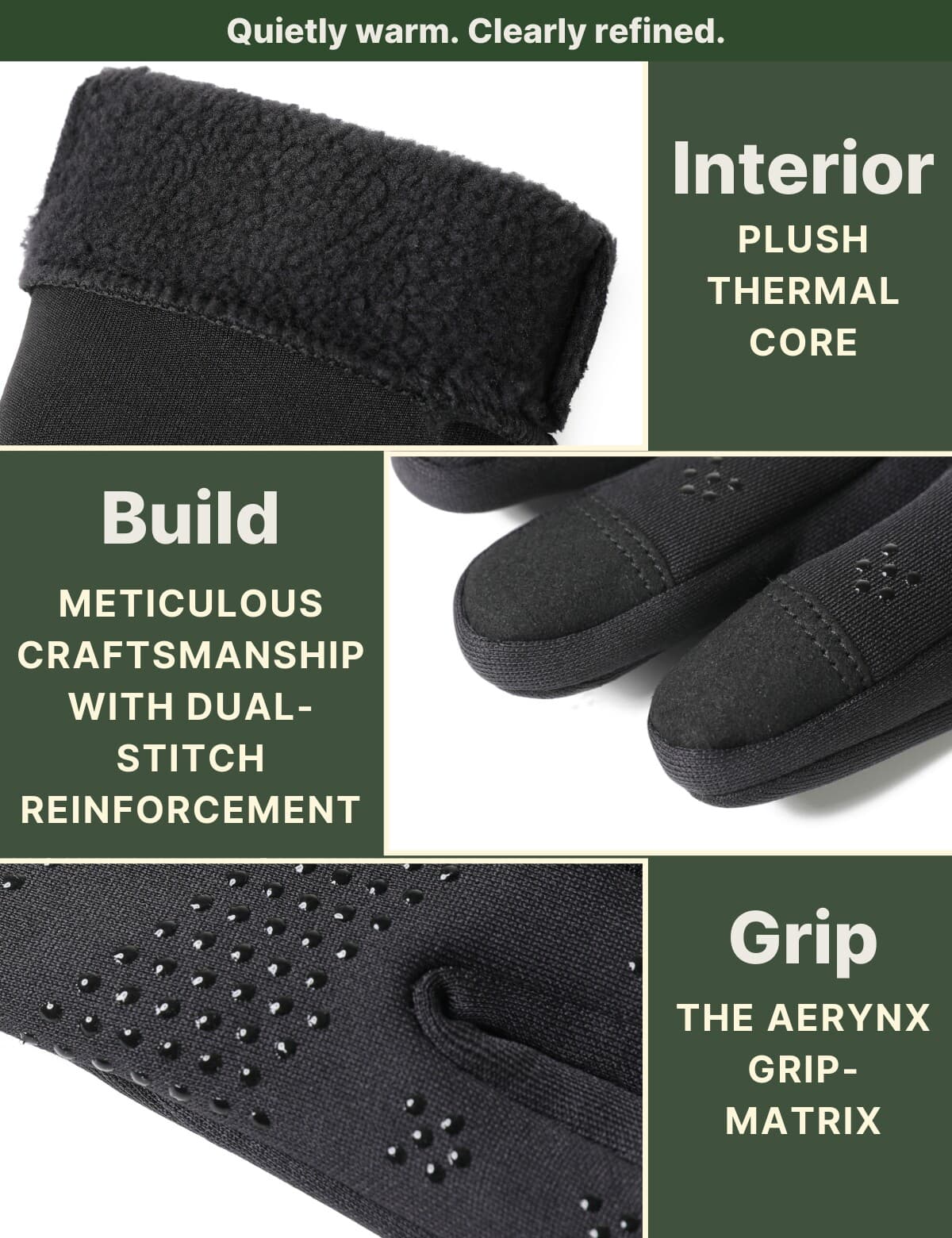
Our own specs follow the same logic. The Aerynx X1 Lite lists 320 gsm fleece, and that figure describes its fleece interior. It is a light, four-way-stretch glove for active wear, water-repellent but not waterproof, with 41–59°F (5–15°C) as brand use guidance for wearing it on its own. That range is not a safety rating, and wind, wet, and effort move it.
The 2026 Aerynx X2 Daily is a three-layer build: a waterproof soft-touch shell, a wind-blocking mid-layer, and a graphene-fiber fleece lining. Here the count maps to three jobs, wet weather, wind, and insulation; our explainer on how graphene gloves work covers what that lining is and is not. X2 is built for wet-weather wear, not soaking or submersion, and water can still find a way in at seams and the cuff. Its 32–50°F (0–10°C) solo-wear figure is brand use guidance.
The Aerynx X3 Winter has six layers: a nylon shell, a membrane, synthetic insulation, a separate waterproof insert, inner insulation, and short-pile fleece. Two of those six, the membrane and the insert, are there to keep water out, and the fleece lining is fixed in place, so allow time for it to dry between outings. We do not publish a temperature rating for X3, and it is not built for soaking; seams can still let water in. Six layers describe a heavier-duty build for still, cold, or wet days, not a multiple of X2's warmth. If you are weighing the three against each other, the winter glove buying checklist starts from your tasks rather than the spec sheet.
GSM and layer questions
Common questions about fleece weight and glove layers
- Does 320 gsm mean the gloves weigh 320 grams?
- No. 320 gsm means one square meter of the fleece fabric weighs 320 grams. A glove uses a small piece of that fabric plus other materials, so the figure says nothing direct about the weight of the glove or the pair.
- Is a six-layer glove twice as warm as a three-layer glove?
- No. Layers do different jobs, and several are usually barriers against wind or water rather than insulation. Warmth depends on how much still air the construction holds, how it fits, and whether it stays dry, which is why a layer count cannot be turned into a multiple.
- If a glove has no EN 511 rating, is it unsuitable for everyday winter use?
- Not necessarily. EN 511 is a standard for protective gloves against cold, and many everyday gloves are simply not sold as protective equipment. Without a rating, judge the glove by its construction, its fit, and the maker's stated use range, and adjust for your conditions.